
Simplifying Business Operations
As companies grow, simplifying business operations becomes increasingly important—and increasingly challenging. Growth is usually a sign that a business is doing something right. More customers. More employees. More locations. New markets. Acquisitions. Expanded services.
But growth brings something else: complexity.
What worked when a company operated from three locations may become increasingly difficult when it operates from thirty or fifty. Processes that once depended on a few familiar people now involve multiple departments, geographic regions, decision-makers, and systems.
Much of that complexity develops behind the scenes. But customers experience those consequences — in inconsistent service, disconnected communications, and interactions that don’t always reflect the same brand.
That’s where business leaders need to pay particular attention and to consider simplifying business operations.
Your Brand Has More Touchpoints Than You Think
A brand is more than a set of corporate identity standards. It’s the cumulative impression people develop through every interaction with an organization.
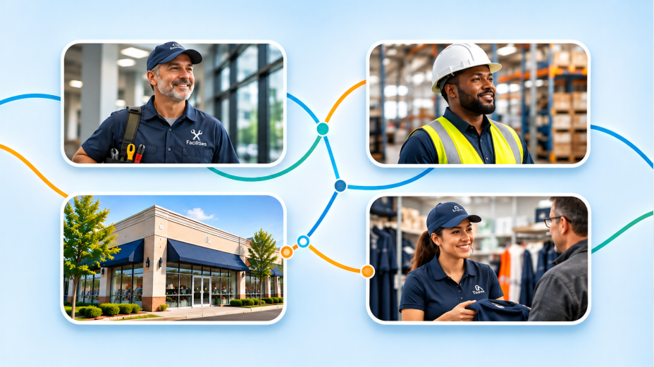
Customers experience a brand through its people, their appearance and interactions, its physical locations, digital platforms, branded materials, and the products and services it delivers. Across different markets and operating divisions, those experiences can vary considerably. Yet every interaction shapes the reputation of the larger organization.
How do you connect those people, places, and experiences without creating an increasingly complicated organization?
Consistency Doesn’t Have to Mean Uniformity
One mistake growing businesses make is assuming that standardization requires everyone to do everything the same way. It doesn’t.
A national organization may need consistent brand standards while accommodating different regional, employee, and departmental requirements. One location may order through a centralized system, another through an approved employee portal, and another through an existing procurement platform.
The opportunity is to connect these different approaches within a unified program that maintains brand standards, simplifies administration, and provides organizational visibility — without sacrificing local flexibility.
The goal: simplifying business operations by standardizing what matters while allowing flexibility where it adds value.
Simplifying Business Operations Across Locations
As organizations expand, they often add processes, suppliers, approvals, and administrative responsibilities. Over time, these create inefficiencies that multiply across employees and locations, consuming valuable time and resources.
Technology can help, but adding another platform isn’t necessarily the answer.
The best technology doesn’t require everyone to change how they work. It connects the ways they already work.
That means finding solutions that integrate existing systems, streamline approvals, automate routine tasks, and accommodate different operational needs.
The objective is to manage complexity behind the scenes, making work simpler for employees and the experience better for customers.
When Employees Are Better Connected, Customers Notice
A consistent customer experience happens when employees across locations and departments have the resources, systems, and support to deliver on those expectations.
Employees who can get what they need without navigating unnecessary obstacles are better positioned to focus on customers. And when departments, locations, and systems work together, the organization is better equipped to deliver a recognizable brand experience.
These are operational improvements, but they’re also investments in the brand.
I don’t believe the answer to organizational complexity is necessarily more management, more technology, or more suppliers. Sometimes it’s fewer handoffs, better-connected systems, clearer responsibilities, and partners who understand the larger business objective.
As companies grow, the challenge isn’t simply managing more moving parts. It’s making them work together.
The more complicated your business becomes, the more important it is to make things simple for the people who represent it and the customers who depend on it.
That’s more than simplifying operations. It’s strengthening the business behind the brand.
Ken Yanicky is a leader at Feury Image Group, where he focuses on helping organizations simplify operations and maintain brand consistency as they grow.
Looking for more practical ideas to simplify your business? Sign up for SOLUTIONS, Feury Image Group’s monthly newsletter featuring insights, ideas, and real-world examples to help your organization work smarter.