
When One Company Starts Acting Like Many
A framework from Feury Image Group for understanding operational complexity in multi-location organizations
Managing multi-location uniform programs for multi-location organizations can quickly become complex. As companies expand across locations, brands, and divisions, programs that once seemed simple—such as employee uniforms, workwear programs, safety apparel, and branded clothing—can become fragmented across vendors, departments, and facilities.
In working with organizations managing these challenges, Feury Image Group often helps companies step back and evaluate how uniforms, safety apparel, and branded materials are structured across their operations.
When I sit down with an executive to talk about their organization, I usually start with a simple question:
Tell me about the structure of your business.
Once a company reaches a certain scale, it rarely behaves like a single company anymore. It begins operating like several organizations at once.
Multiple locations.
Multiple brands.
Different teams with different needs.
Different vendors doing different things.
At that point, the challenge isn’t simply growth — it’s complexity.
Organizations managing employee uniform programs across multiple locations often struggle with consistency, visibility, and scalability as these layers build over time.
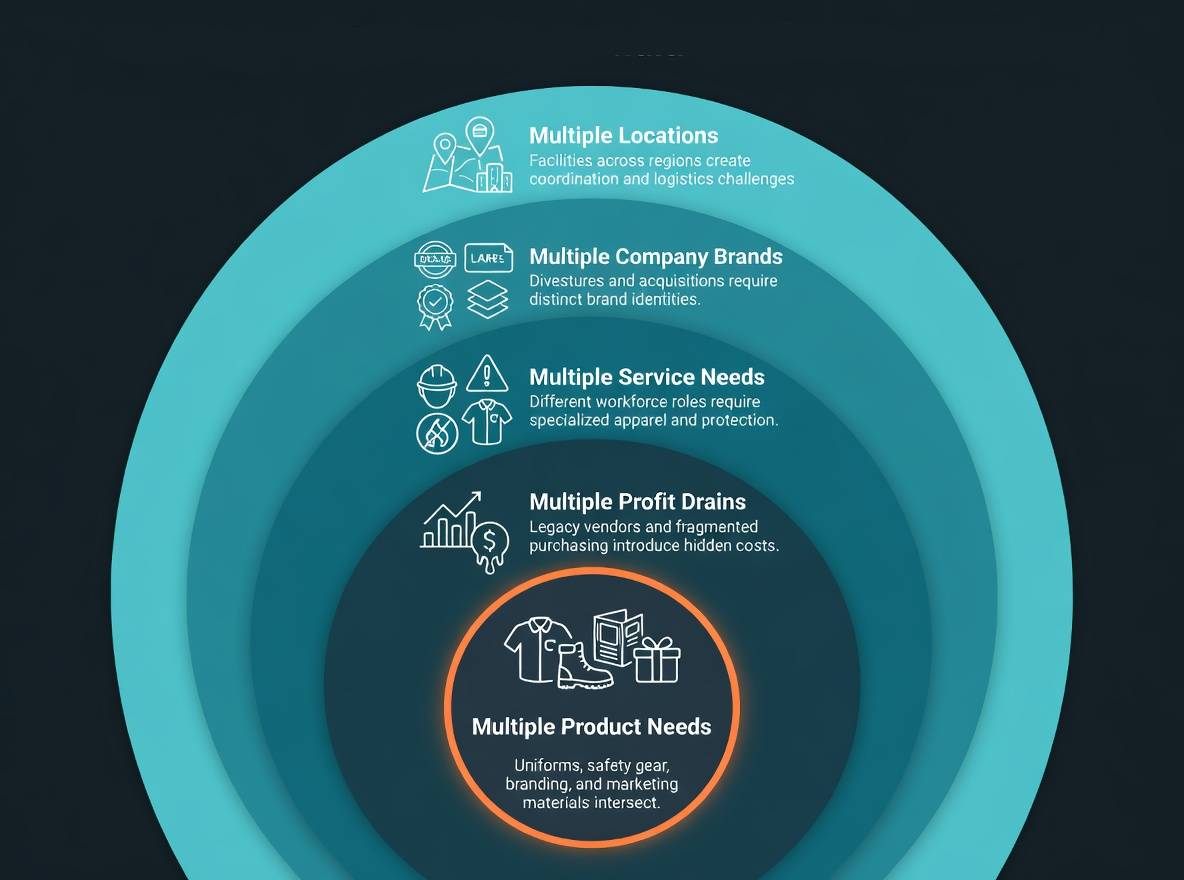
The 5 Layers of Complexity in Multi-Location Organizations
As organizations grow, complexity doesn’t appear all at once—it builds in layers. Most companies don’t set out to create complicated systems. Complexity develops gradually as the organization expands.
Multiple Locations
The first layer is geography.
Organizations operating across multiple locations or regions often develop location-specific processes, vendor relationships, and purchasing habits. While those decisions may make sense locally, maintaining consistency across the entire organization becomes increasingly difficult.
A uniform program that works well for one facility can quickly become difficult to manage across dozens—or hundreds—of sites.
Multiple Company Brands
The next layer often comes from brand structure.
Many organizations expand through acquisitions, new divisions, or entry into new markets. As a result, they may manage several brand identities simultaneously, each with its own expectations, audiences, and standards.
Maintaining brand consistency across locations while supporting these differences requires coordination that many organizations underestimate.
 Multiple Service Needs
Then we look at the workforce itself.
Different roles require different kinds of support. Some employees need standard uniforms, while others require specialized workwear, protective apparel, or compliance-driven garments.
In many environments, this includes safety apparel and flame-resistant clothing, which adds another layer of operational responsibility and compliance.
What begins as a simple uniform program often expands into a broader workforce support system.
Multiple Profit Drains
At this stage, many organizations begin to recognize another reality: small inefficiencies add up.
Legacy vendor relationships remain in place. Rental programs continue because they’ve always existed. New requirements introduce new suppliers. Purchasing decisions are spread across departments and locations.
Individually, these decisions make sense. Collectively, they often create hidden costs and operational inefficiencies.
Multiple Product Needs
Finally, organizations begin to see the full scope of what they actually support.
Operational needs rarely stop at uniforms. Many organizations also manage:
- Safety apparel and PPE
- Safety footwear programs
- Corporate branded apparel
- Promotional products
- Printed materials and signage
Each category may be handled separately, but from an operational standpoint, they are often interconnected.
How Complex Is Your Organization?
When we begin conversations with organizations, these are often the first questions we ask.
Organizational Structure
- Do you operate multiple locations or facilities?
- Do different locations use different vendors for uniforms or workwear?
- Do you manage multiple brands, divisions, or business units?
Workforce Needs
- Do different roles require different types of uniforms or workwear?
- Do some employees require safety apparel or compliance garments?
- Do certain teams require branded clothing or promotional apparel?
Program Management
- Are uniforms, safety gear, and promotional apparel handled by different vendors?
- Are purchasing decisions decentralized across departments or locations?
- Is it difficult to track total program costs across the organization?
If several of these sound familiar, your organization may be managing a level of complexity that traditional uniform or workwear programs were never designed to support.

Managing Multi-Location Uniform Programs Across Complex Organizations
For many organizations, one of the clearest examples of operational complexity appears in how uniform programs are managed.
A program that begins in one location often expands across multiple facilities, each with different workforce needs, safety requirements, and brand standards.
Without a coordinated structure, organizations often manage:
- separate vendors
- separate ordering systems
- separate policies
Over time, this fragmentation creates administrative challenges and limits visibility into costs and program performance.
Organizations that successfully manage multi-location workwear programs typically move toward systems that allow programs to scale while maintaining consistency across the enterprise.
Why Traditional Uniform Program Approaches Break Down
Traditional procurement models were built for simpler organizations—one location, one brand, one category of need. But as organizations grow, those models begin to strain.
Programs become fragmented.
Costs become harder to track.
Administrative effort increases.
At that point, the issue isn’t simply finding another vendor. The issue is structural.
Built Around the Organization
Organizations that successfully manage this level of complexity often begin by stepping back and evaluating the full scope of their operational needs.
They start to view their programs not as isolated purchases, but as interconnected systems. They look for ways to support multiple locations, brands, and workforce requirements within a coordinated framework.
In our work with organizations managing these challenges, we’ve found that this shift often reveals opportunities to simplify systems, improve consistency, and reduce hidden costs.
In other words, successful organizations move away from one-size-fits-all approaches and toward solutions built around how their business actually operates.
A Different Way to Think About the Problem
At a certain point, the challenge isn’t simply finding another vendor or launching another program. It’s recognizing that the structure supporting those decisions may no longer fit the way the organization operates.
When companies take a step back and look at the full scope of their locations, brands, workforce needs, and operational demands, they often realize the issue isn’t complexity itself — it’s that the systems managing that complexity were never designed for it.
The organizations that move forward successfully are the ones that begin thinking about their operations as an integrated framework — built around how their business actually works.
Evaluating Your Organization’s Uniform Program
If your organization manages multiple locations, brands, or workforce requirements, evaluating the structure behind your uniform and workwear programs can reveal opportunities to simplify operations and improve visibility across the enterprise.
Organizations exploring these challenges often begin with a conversation about how their programs are currently structured.
Continue the Built Around You Series
Built Around You is an ongoing Feury Image Group thought leadership series exploring workforce visibility, operational consistency, safety, branding, and apparel program management.
- Why organizations are reevaluating legacy apparel models:
Uniform Rental vs. Purchase - How customization impacts morale, identification, and consistency:
Customization and Personalization of Uniforms - The relationship between workwear and employee engagement:
Workwear, Employee Performance, and Engagement - Building high-visibility programs that function in real operations:
High-Visibility Safety Apparel Programs That Work
About the Author
 Ken Yanicky
Vice President
Feury Image Group
Ken works with organizations managing complex operational programs across multiple locations, brands, and workforce needs, helping them bring structure and scalability to uni form, safety apparel, and branded workwear programs.