
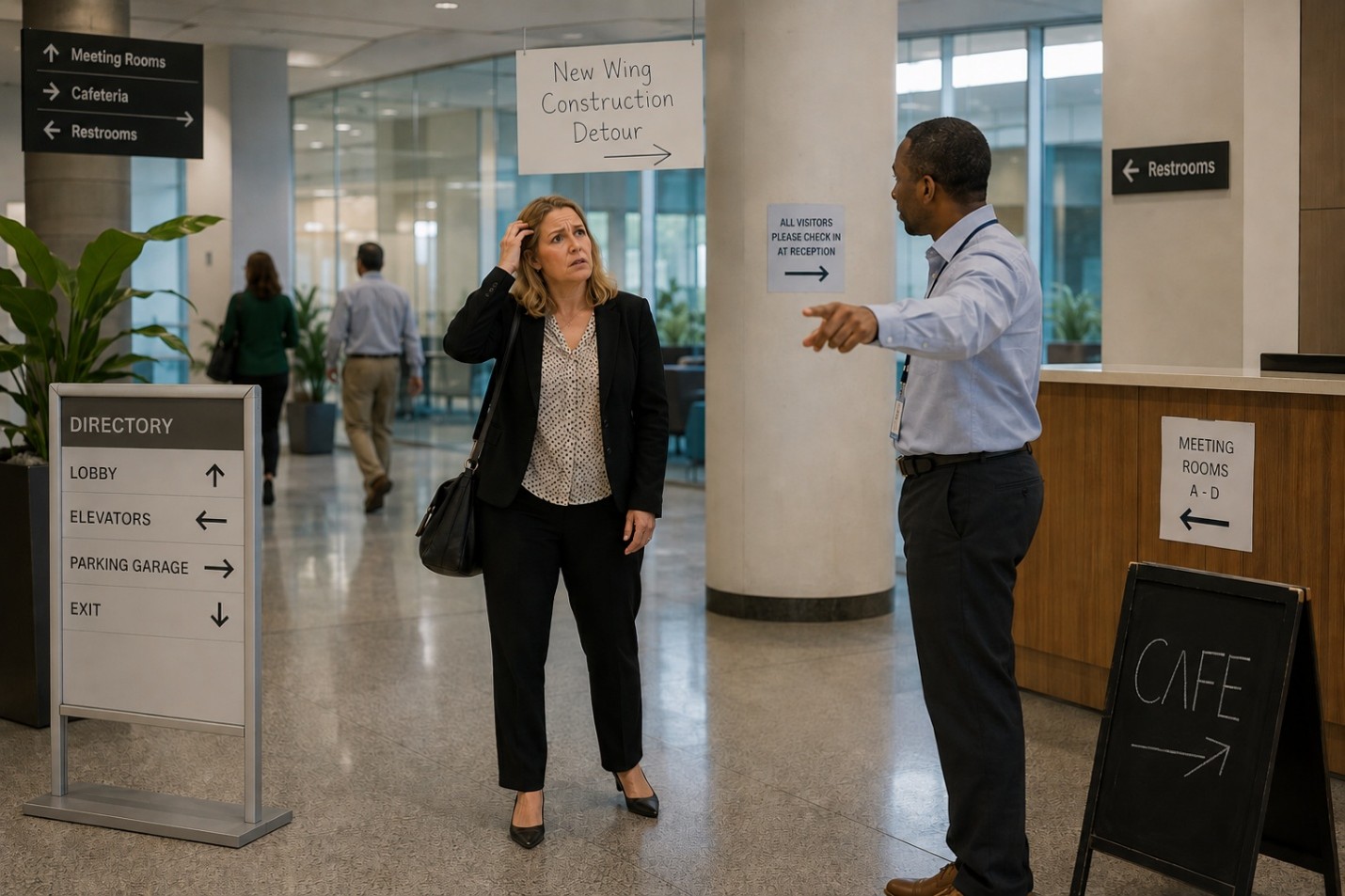
Most organizations never decide to redesign their signage system.
Instead, signage changes gradually. An organization refreshes its brand. A renovation creates a new entrance. Departments relocate. New facilities come online or campuses expand, parking operators take on additional locations, and manufacturers reconfigure production areas to improve efficiency. Retailers introduce new services and seasonal promotions.
Each change makes perfect sense at the time. Viewed individually, they’re simply practical business decisions. Taken together over several years, however, they begin to reshape how people experience the organization.
Every organization has a signage system. The only question is whether it was intentionally designed or simply evolved over time.
Why It Matters
Today, wayfinding and environmental graphics are recognized as important components of the overall visitor and employee experience, particularly in complex environments such as healthcare campuses, universities, transportation systems, and multi-building corporate facilities. Research continues to show that clear navigation reduces confusion, lowers stress, and helps people move through unfamiliar environments more confidently. These benefits extend well beyond aesthetics; they directly support daily operations and organizational effectiveness.
If any of the following situations sound familiar, it may be time to step back and evaluate your signage as a complete system rather than as a series of individual projects.
Sign 1: People Still Ask for Directions
One of the clearest indicators that a signage system is no longer working is surprisingly simple: people keep asking for help and your employees become part of the wayfinding system.
Visitors stop employees to ask for directions. Delivery drivers search for the correct entrance. New employees rely on coworkers to navigate an unfamiliar facility. Customers overlook new services because they aren’t clearly identified. Before long, employees become part of the wayfinding system—answering questions the environment itself should answer.
While each incident may seem minor, together they reveal a facility that depends on employees rather than its physical environment to guide people successfully.
Wayfinding experts have long recognized that navigation is closely tied to a visitor’s overall experience. In healthcare environments especially, poorly designed wayfinding contributes to stress, confusion, and lost time—precisely when people are already under pressure. (NIH)
Good signage quietly removes those obstacles. The best systems often go unnoticed because they simply allow people to arrive where they need to be without thinking about the journey.
Sign 2: Temporary Solutions Have Become Permanent
Walk through almost any growing organization and you’ll probably find them.
It might be a temporary directional sign installed while a hospital expands, promotional graphics created for a seasonal retail campaign, revised parking instructions during a garage renovation, or updated safety notices posted while a manufacturing facility reorganizes its production floor. These temporary solutions solve immediate problems, but they’re often still in place long after those problems have been resolved.
The problem isn’t the temporary sign. The problem is when temporary solutions quietly become permanent fixtures.
Over time they create visual clutter, compete with official signage, and gradually reduce confidence that the facility is communicating clearly. More importantly, they often signal that no one is looking at the entire signage system as a whole.
Sign 3: Every Location Tells a Different Story
This challenge often appears as organizations expand.
One office has updated lobby graphics reflecting the current brand. Another continues displaying a previous logo. Directional signs vary from building to building because they were ordered locally over several years. Materials, colors, terminology, and installation methods differ—not because anyone intended inconsistency, but because each project was completed independently.
Eventually, visitors experience several versions of the same organization depending on which location they happen to visit. One office feels contemporary and well organized, another feels dated, and a third communicates something entirely different. Consistency gradually gives way to improvisation.
It’s a pattern we’ve discussed throughout our Built Around You series. Growth and time naturally introduce complexity. Without shared standards and centralized oversight, systems that once worked independently begin pulling in different directions.

Well-designed signage systems don’t draw attention to themselves—they help people navigate confidently while reinforcing a consistent organizational identity.
Sign 4: Your Facility No Longer Reflects Your Organization
Buildings begin communicating long before employees have an opportunity to. Long before someone shakes hands with a salesperson, meets a receptionist, or speaks with a department manager, they’re already forming impressions. Is this organization organized? Does it feel current? Is it easy to navigate? Does it inspire confidence? The physical environment answers those questions before a conversation ever begins.
The condition of exterior signs, lobby graphics, environmental branding, meeting spaces, and workplace messaging all contribute to first impressions. Prospective employees notice them. Customers notice them. Patients notice them. Business partners notice them.
Increasingly, organizations are investing in environmental graphics to reinforce culture, improve workplace experience, and strengthen physical spaces. Industry research shows planned use of wall wraps and environmental graphics continuing to grow, reflecting a broader recognition that facilities themselves have become important communication tools. (MDPI)
When the physical environment no longer reflects the organization inside it, that disconnect becomes part of the visitor experience.
Sign 5: Growth Has Outpaced Your Signage
Organizations evolve continuously.
Departments relocate. New services are introduced. Parking areas expand. Security requirements change. Acquisitions add new buildings that bring their own signage standards and visual identities.
The signage, however, often remains tied to an earlier version of the organization.
Visitors continue entering through former main entrances. Employees rely on institutional knowledge to compensate for outdated directional systems. New facilities never quite feel connected to existing ones because visual standards were never extended beyond the original campus.
Growth is healthy and desirable. But growth deserves a signage system capable of growing with it. But adding more signs isn’t the same as improving a signage system. As organizations become more complex, the system that guides employees, visitors, customers, and partners must evolve with them.
Sign 6: No One Owns the System
Perhaps the most common issue isn’t the condition of the signs themselves. It’s the ownership.
Marketing oversees brand standards. Facilities replaces damaged signs. Operations orders safety graphics. Human Resources requests office identification. Individual locations purchase what they need as situations arise.
Everyone manages a piece of the system, but no one manages the system itself.
That’s often when organizations discover they’re spending more time coordinating signage than actually improving it—a situation remarkably similar to fragmented uniform programs, where independent purchasing decisions gradually create unnecessary complexity.
“Most organizations don’t wake up one day with a signage problem,” says Ken Yanicky, Vice President of Feury Image Group. “Departments move, buildings expand, new locations come online, and temporary solutions become permanent. A series of practical decisions becomes a system. That’s when it’s worth stepping back and looking at the entire experience—not just the next sign that needs to be replaced.”
Every Organization Has a Signage System.
The only question is whether it was intentionally designed—or simply evolved over time.
When Is the Last Time You Evaluated Your Entire Signage System?
By this point, the question isn’t whether your organization has signage.
It’s whether that signage still reflects the way your organization operates today.
Organizations that periodically step back and evaluate the entire system often discover opportunities to improve navigation, strengthen brand consistency, reduce confusion, and better support day-to-day operations.
A thoughtful signage review isn’t about replacing signs that still work. It’s about understanding how people experience your organization from the moment they arrive until the moment they leave.
The most effective organizations periodically pause to ask a different question. Instead of wondering what sign needs to be replaced next, they ask whether the entire environment still reflects the way the organization operates today. That shift in perspective often reveals opportunities that individual projects never could.
A thoughtful signage review isn’t about replacing signs that still work. It’s about understanding how people experience the organization from the moment they arrive until the moment they leave.
- Can they find their destination?
- Does every location communicate the same identity?
- Are employees spending time giving directions that the facility itself should provide?
- Does the environment reinforce confidence, clarity, and professionalism?
Those are operational questions. The answers often have very little to do with signs themselves.
Built Around You
At Feury Image Group, we’ve learned that the most effective signage systems are rarely the most noticeable. They simply help organizations operate more smoothly by guiding visitors, supporting employees, reinforcing brand standards, improving safety, and creating consistent experiences across every location.
Like every solution we provide, the conversation begins by understanding how your organization operates today—not simply identifying the next project. The goal is to build systems that work better.
Key Takeaway
Organizations rarely outgrow their signage all at once. It evolves alongside renovations, expansions, rebranding efforts, and operational changes. Periodically stepping back to evaluate the entire signage system—not just individual signs—can improve navigation, strengthen brand consistency, reduce confusion, and better support the way your organization operates today.
Signage is only one part of an organization’s operational communication system. Employee apparel, environmental graphics, printed materials, vehicle graphics, promotional campaigns, and workplace branding all shape how employees, customers, and visitors experience your organization. When those elements are planned together, they reinforce one another—creating greater consistency, improving operational efficiency, and strengthening your brand at every touchpoint.
Frequently Asked Questions
What is a signage audit?
A signage audit is a comprehensive review of an organization’s visual communication system. Rather than evaluating individual signs in isolation, it examines how exterior identification, wayfinding, interior graphics, safety signage, branding, and environmental graphics work together to support employees, visitors, and day-to-day operations. A signage audit often identifies inconsistencies, outdated messaging, navigation challenges, and opportunities to improve the overall experience without necessarily replacing every sign.
How often should organizations review their signage?
Most organizations don’t need to review their signage on a fixed schedule. Instead, it’s best to evaluate the system after significant organizational changes, such as a renovation, brand refresh, acquisition, campus expansion, new service line, or operational reconfiguration. These milestones often create gradual changes that affect how people move through a facility and how consistently the organization presents itself.
What is wayfinding signage?
Wayfinding signage helps people understand where they are, where they need to go, and how to get there. It includes directional signs, building identification, room identification, maps, parking guidance, and informational graphics. An effective wayfinding system reduces confusion, minimizes interruptions for employees, and helps visitors navigate unfamiliar environments with greater confidence.
What is environmental branding?
Environmental branding uses graphics, signage, colors, and architectural elements to communicate an organization’s identity throughout its physical spaces. Lobby graphics, wall murals, branded meeting rooms, workplace messaging, and exterior identification all contribute to the experience employees, customers, patients, and visitors have when they enter a facility. When thoughtfully planned, environmental branding reinforces organizational culture while creating a more cohesive and memorable environment.
How can better signage improve the visitor experience?
Effective signage helps visitors find their destination quickly, understand where they are, and navigate unfamiliar facilities with confidence. Clear identification and wayfinding reduce frustration, minimize the need to ask for directions, and create a more positive first impression. In healthcare, education, transportation, corporate, and retail environments, well-designed signage supports a smoother, more intuitive experience from arrival through departure.
How do organizations maintain consistent signage across multiple locations?
Consistency begins with shared standards rather than individual purchasing decisions. Organizations often develop guidelines for logos, typography, colors, terminology, materials, placement, and installation so every location communicates the same identity. Managing signage through a coordinated program also simplifies future updates as facilities expand, relocate departments, or introduce new services.
What’s the difference between replacing signs and reviewing a signage system?
Replacing a sign addresses a specific need, such as updating a logo, changing a department name, or replacing a damaged panel. Reviewing a signage system takes a broader view by examining how all of the organization’s visual communications work together. The goal is to improve navigation, reinforce brand consistency, support safety, and ensure the entire environment reflects how the organization operates today—not just to replace individual signs.
Why should organizations think of signage as an operational system rather than a collection of individual signs?
As organizations grow, signage often evolves one project at a time. Renovations, relocations, new services, acquisitions, and temporary solutions gradually shape how people experience a facility. Looking at signage as an operational system helps organizations improve navigation, support employees, strengthen brand consistency, and create a better experience across every location. The goal isn’t simply to install signs—it’s to ensure the entire environment communicates clearly and works together as intended.
Related Operational Solutions
Organizations that take a holistic look at their signage often identify opportunities to strengthen other aspects of their visual communication and workforce presentation, including:
Environmental Graphics & Workplace Branding
Transform lobbies, offices, healthcare environments, and common spaces into branded experiences that reinforce culture and improve the visitor experience.
Workforce Identification
Branded apparel, employee identification, and name personalization help extend your organization’s visual identity beyond the building and into every customer interaction.
Printed Communications
Coordinate brochures, menus, point-of-sale materials, event graphics, and informational signage so printed materials support the same messaging and visual standards as your facility.
Promotional & Event Graphics
Support seasonal campaigns, community events, grand openings, trade shows, and internal initiatives with coordinated banners, displays, branded merchandise, and promotional materials.
Multi-Location Brand Standards
Establish consistent guidelines for signage, graphics, printed materials, and employee presentation across every location.
Continue the Built Around You Series
- Why Workforce Programs Should Be Designed, Not Purchased
- FR/AR Programs Built for Real Operations
- Beyond the Uniform
What Does a Holistic Signage Review Include?
A comprehensive signage review typically evaluates:
- Exterior identification
- Wayfinding and navigation
- ADA accessibility
- Safety and compliance messaging
- Interior graphics and environmental branding
- Brand consistency across locations
- Multi-location standards
- Maintenance and lifecycle planning
The goal isn’t simply to replace signs—it’s to ensure the entire system supports the way your organization operates today.