
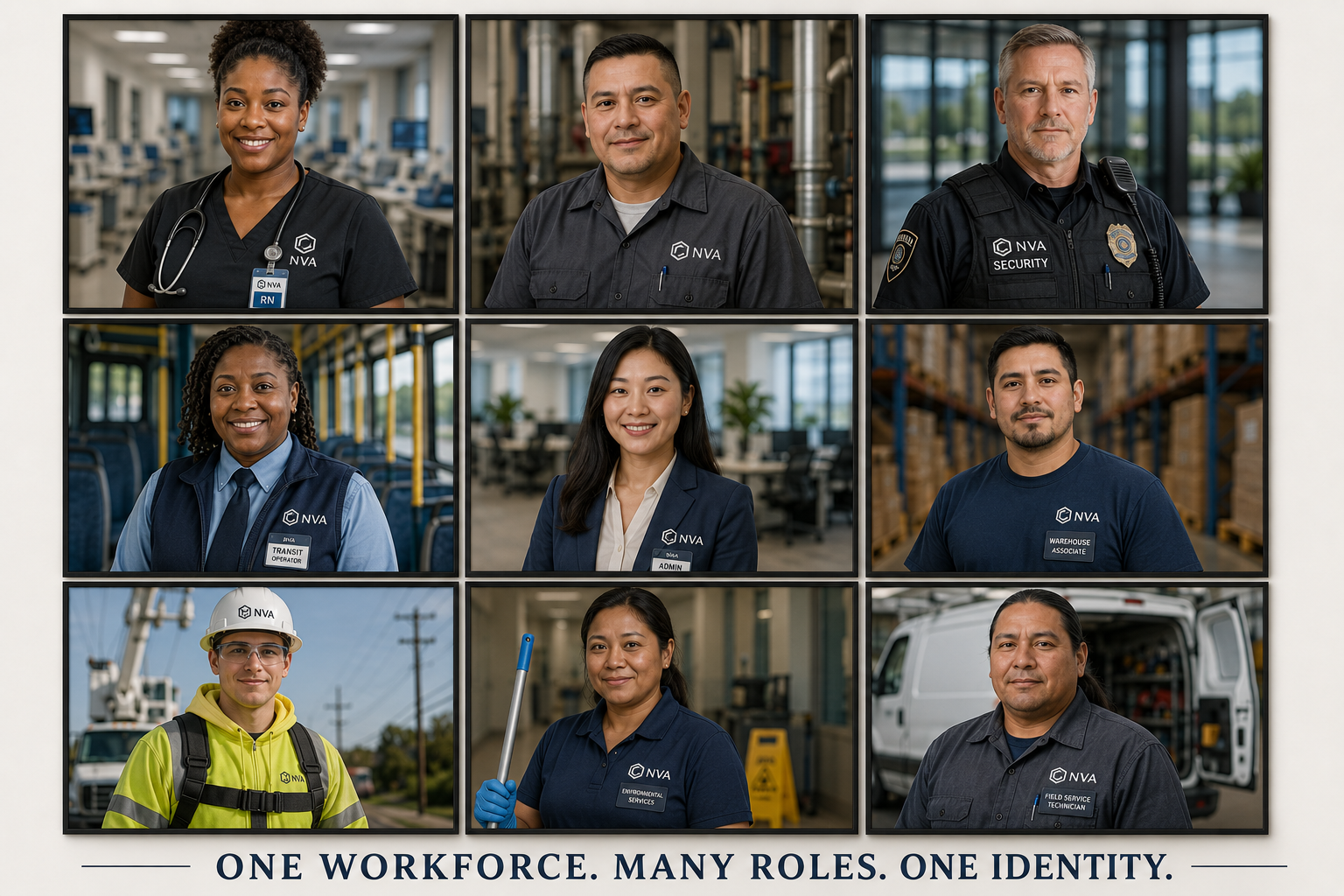
Why the best uniform programs start with the employee—not the apparel.
Most people think a uniform program is about apparel.
That approach may work for a small organization. It becomes far more difficult as the workforce grows across departments, locations, and job functions. As organizations grow, the question quietly changes.
It’s no longer “What uniform should we buy?”
It becomes “How do we make sure every employee receives exactly the right uniform for the work they perform?”
A uniform does far more than dress an employee. It identifies them. It communicates their role, helps customers or patients recognize them, distinguishes departments, reinforces safety requirements, and represents the organization’s brand long before a conversation begins.
Research published in the Journal of Applied Social Psychology suggests uniforms do even more. Customers naturally associate uniformed employees with the organizations they represent, meaning that interactions with one uniformed employee can influence perceptions of the entire company.
That’s why the most successful organizations no longer think of uniforms as clothing.
They think of them as an extension of workforce identity.
More Than a Logo
Whether it’s a hospital caregiver, utility worker, or facilities technician, a uniform answers questions before an employee speaks. Who is this? What do they do? Can they help me?
The answers are communicated through dozens of details that most people barely notice consciously: the garment itself, the fit, the color, a name embroidered over the pocket, a department identifier, a certification patch, reflective striping, or a branded jacket appropriate for the season.
Each detail contributes to the employee’s identity within the organization.
“People often think the conversation starts with a logo,” says Ken Yanicky, Vice President of Business Development at Feury Image Group. “It really starts with the employee. Once you understand the person’s role, environment, and responsibilities, the right apparel decisions become much clearer.”
Workforce Identity Gets More Complicated as Organizations Grow
Small organizations often don’t notice the transition. It happens gradually. A second location opens. A new department is added. Women’s sizing becomes a larger consideration as the workforce evolves.
Soon, different departments require different apparel, locations establish separate approval processes, safety standards evolve, and acquisitions introduce new brands.
Individually, none of these changes seems particularly difficult. Collectively, they create hundreds—or even thousands—of unique combinations that must be managed accurately and consistently.
At that point, the challenge isn’t ordering uniforms. It’s maintaining workforce identity across an increasingly complex organization.
Every employee represents your organization differently. The goal isn’t to make everyone look the same. It’s to build a consistent process that delivers the right apparel, identification, and personalization for every role.
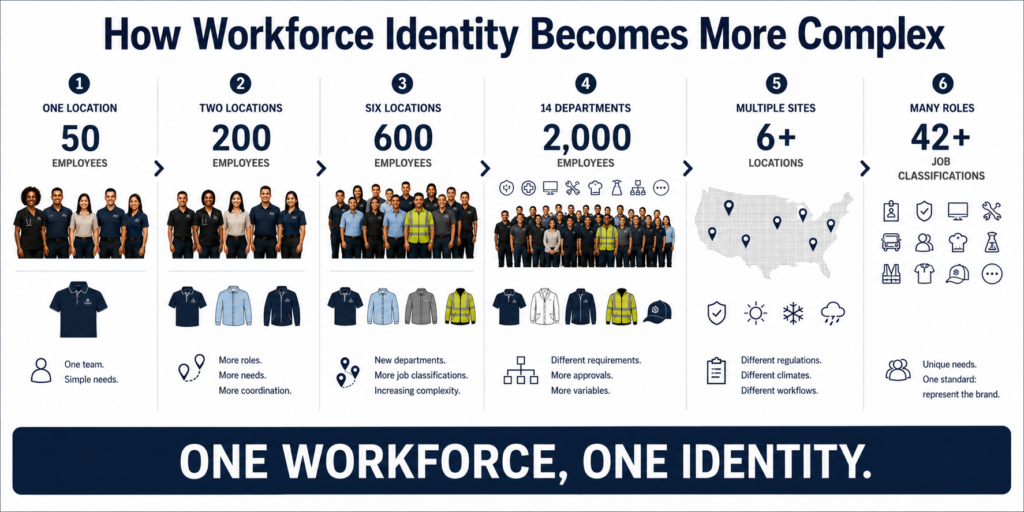
As organizations grow, workforce apparel becomes increasingly complex. The challenge shifts from buying uniforms to delivering the right apparel, identification, and personalization for every employee and every role.
Every Detail Communicates Something
Every employee’s apparel reflects the work they perform. A customer-facing employee may need an embroidered polo, while an industrial worker requires flame-resistant apparel with reflective identification. A healthcare system may use color-coded scrubs to distinguish departments and improve patient recognition.
None of these decisions is cosmetic. They communicate identity.
That’s why experienced program managers don’t begin by choosing a decoration method. They begin by understanding the employee’s role, then select the apparel and identification techniques that best support it.
Consistency Builds Confidence
Research published in the Journal of Applied Social Psychology found that customers naturally associate uniformed employees with the organizations they represent. That makes every employee a visible ambassador for the brand, reinforcing the importance of consistent identification across departments and locations.
“We’re not trying to make every employee look identical,” Yanicky explains. “We’re trying to make sure every employee is immediately recognizable in the role they’re there to perform. That’s a very different objective.”
Building Programs Around People
No two employees are exactly alike. A customer-facing service representative has different needs than a warehouse associate. A healthcare worker requires different identification than a facilities technician. Safety requirements, work environments, body types, and day-to-day responsibilities all influence what an employee should wear and how they should be identified.
The best uniform programs aren’t designed around garments. They’re designed around people.
That’s why successful organizations begin by understanding the employee, the work they perform, and how they need to be recognized. Only then do they decide what apparel, personalization, identification, or decoration best supports that role.
The result isn’t simply a better uniform program.
It’s a workforce that is consistently identified, confidently presented, and better prepared to represent the organization every day.
Key Takeaway
The strongest uniform programs aren’t built around products or decoration methods. They’re built around workforce identity. When organizations understand the employee before selecting the apparel, they create greater consistency, reduce errors, strengthen their brand, and improve the experience for everyone who wears the uniform.
Continue the Built Around You™ Series
Every organization faces different workforce apparel challenges. Explore the rest of the Built Around You™ Series to learn how leading organizations build apparel programs that improve consistency, simplify administration, support employee performance, and strengthen their brand.
Continue reading:
- Who Actually Owns Your Uniform Program?
- The Most Valuable Uniform Item May Be the Cap
- Why More Companies Are Reconsidering Uniform Rental Programs
- Customization and Personalization of Uniforms
- Recruit, Retain and Reward Programs
Frequently Asked Questions
Why shouldn’t every employee wear the same uniform?
Different roles have different responsibilities, safety requirements, work environments, and customer interactions. The most effective uniform programs provide apparel that is appropriate for each employee’s specific job while maintaining a consistent brand identity across the organization.
How do large organizations manage different uniform requirements?
Successful organizations create structured uniform programs based on job roles, departments, locations, and approval workflows. Modern managed apparel programs use online portals, role-based catalogs, and automated approval processes to ensure every employee receives the correct apparel and personalization.
What is workforce identity in a uniform program?
Workforce identity is the combination of apparel, colors, logos, name embroidery, department identifiers, certifications, and safety features that immediately communicate who an employee is and what role they perform. A well-designed program helps employees be recognized quickly and consistently.
How does personalization improve a uniform program?
Personalization—such as embroidered names, department designations, certifications, or employee-specific identifiers—helps customers, patients, visitors, and coworkers identify the right person more quickly while reinforcing professionalism and organizational consistency.
What should organizations consider before selecting uniform apparel?
Before choosing garments, organizations should evaluate each employee’s job function, work environment, safety requirements, mobility needs, climate, frequency of wear, and customer interaction. Understanding the employee’s role first leads to better apparel decisions and fewer program challenges over time.
Can one uniform program support many departments and locations?
Yes. The strongest managed apparel programs are designed to accommodate multiple departments, facilities, job classifications, and geographic locations while maintaining consistent branding, ordering processes, and employee identification throughout the organization.
How do better uniform programs reduce errors?
Role-based ordering, standardized garment selections, approval workflows, and employee-specific personalization help ensure that each employee receives the correct apparel, reducing ordering mistakes, returns, duplicate purchases, and administrative effort.
What makes a managed uniform program different from simply buying uniforms?
A managed uniform program focuses on the entire employee lifecycle—not just purchasing apparel. It includes employee onboarding, role-based product selection, personalization, approvals, inventory management, reporting, and ongoing program administration to ensure every employee receives the right uniform every time.
Built Around Your Organization.
Whether you’re outfitting 100 employees or 10,000, Feury Image Group helps organizations design managed apparel programs that deliver the right apparel to the right employee at the right time.