

What Did Your Organization Actually Spend Last Year to Outfit Its Workforce?
While it may sound like a simple question, for many organizations, the answer to this question about fragmented uniform programs may not be that easy to determine.
Procurement may know what was spent with the uniform supplier, while Compliance may oversee flame-resistant clothing, high-visibility apparel or safety footwear. Individual locations may make occasional purchases themselves, and employees may buy approved work boots and submit expenses for reimbursement. Meanwhile, Human Resources may administer employee allowances while Accounting oversees invoices and expense reports from several different sources.
Each process may work reasonably well on its own, but a problem emerges when you put them all together.
Uniform programs often become fragmented gradually, as organizations grow, add locations, accommodate new job requirements and develop separate processes to solve individual needs. And the costs of that fragmentation often extend well beyond the prices printed on apparel and footwear invoices.
The Price of a Uniform Is Not the Cost of a Uniform Program
When organizations evaluate uniform costs, the natural place to start is product price.
What does the shirt cost? What are we paying for work pants? Can we get the jacket for three dollars less somewhere else? What is our annual spend with the uniform supplier?
Those are all legitimate questions, but they don’t capture the entire cost of getting the right apparel and footwear to the right employees.
Someone also has to determine what employees are eligible to receive, collect sizes, place orders, obtain approvals, answer questions, manage allowances, track shipments, process returns, resolve mistakes, reconcile invoices and replenish inventory.
Then there may be freight charges, expedited orders, obsolete inventory and employee reimbursements. Those costs are real even though they may never appear under a line item labeled uniform program.
Independent procurement research demonstrates how meaningful the process itself can be. APQC benchmarking found that organizations spend from approximately $14 to more than $54 simply to process a single purchase order, with differences driven largely by how procurement work is structured and executed.
What the Invoice Doesn’t Show
Imagine a growing organization with 125 employees across four locations. Its employees have varied needs.
Customer-facing employees wear branded polos and outerwear. Field employees need durable workwear and high-visibility garments. Certain technical employees require flame-resistant (FR) clothing. Some employee positions need approved safety footwear. Managers have their own apparel requirements, and new employees need to be outfitted throughout the year.
Like many uniform programs, this one developed gradually. One supplier provides much of the standard apparel. Another supplies certain specialized garments. Safety footwear is handled separately. Some inventory is kept at individual locations. Managers place replacement orders when necessary. Employees occasionally purchase approved items themselves and submit reimbursements.
None of this seems unusual, which is exactly the point. Fragmentation doesn’t happen because someone designed a bad uniform program. It develops through one reasonable workaround at a time.
Hidden Cost #1: The People Behind the Program
Consider how many people may touch a uniform order before an employee actually wears the garment.
A supervisor identifies the need. An administrator verifies eligibility. Someone confirms the size. A manager approves the order. Purchasing issues the purchase order. Accounting processes an invoice. If something goes wrong, one or more of those people become involved again.
Multiply those activities across new hires, replacements, seasonal requirements, employee turnover and multiple locations, and relatively small amounts of time can accumulate.
As the APQC research cited earlier demonstrates, purchasing itself carries an internal administrative cost. Uniform administration can involve much more: determining eligibility, collecting sizes, obtaining approvals, answering questions, tracking shipments, processing returns and resolving problems.
That time may never appear on a uniform invoice, but it is still part of what the program costs to operate.
Hidden Cost #2: Small Orders Become Expensive Orders
Uniform needs rarely arrive on a perfectly convenient schedule.
Three employees start next Monday. A location runs out of a commonly needed size. An employee damages a jacket. Someone needs a new pair of safety boots. A supervisor discovers that an employee was left off the previous order.
The organization solves each problem. But a fragmented program can turn these routine needs into a continuing stream of small orders, separate shipments and occasional expedited freight.
Each charge may seem relatively minor on its own. Over the course of a year, however, they become another part of the program’s total cost—one that may be difficult to see if freight and rush charges are spread across vendors, locations and individual orders.
The more useful question for organizations suffering from fragmented uniform programs is: Do we know how much we’re spending this way?
Hidden Cost #3: Returns, Replacements and Rework
The wrong size arrives.
The correct garment has the wrong logo.
An employee receives a product intended for another department.
An order goes to the wrong location.
Two people order the same replacement.
Each mistake has an obvious product cost. But it also creates another administrative process—from identifying the problem and communicating with the employee to arranging a return, tracking a credit or ordering a replacement.
Reducing errors can therefore reduce both direct costs and the administrative time spent correcting them.
Hidden Cost #4: Inventory Nobody Intended to Own
Local uniform inventory often begins with good intentions. A manager keeps a few extra shirts for new employees. Another location stocks common sizes so replacements are available immediately. Someone orders additional jackets in anticipation of winter.
Over time, inventory accumulates.
Employees leave. Sizes change. A garment is discontinued. Branding is updated. One location may have products it no longer needs while another orders more of the same items.
Excess, unusable or obsolete apparel represents money the organization has already spent but is no longer putting to productive use.
Effective uniform inventory management isn’t simply about having less inventory. It’s about having better visibility into what the organization already owns, where it is and when it needs to be replenished.
Hidden Cost #5: Outfitting One Employee Through Several Different Systems
Fragmented uniform programs are not just about how many uniform vendors an organization uses. It’s about how many separate processes are involved in outfitting its employees.
Take, for example, a single field employee. Branded work shirts may be ordered through the company’s uniform program. A supervisor may manage FR clothing separately. High-visibility apparel may be stocked at the employee’s location. Safety footwear may be handled through an employee allowance or reimbursement process. Outerwear may be issued seasonally by a manager.
ONE EMPLOYEE. FIVE PROCESSES: FRAGMENTED UNIFORM PROGRAMS.
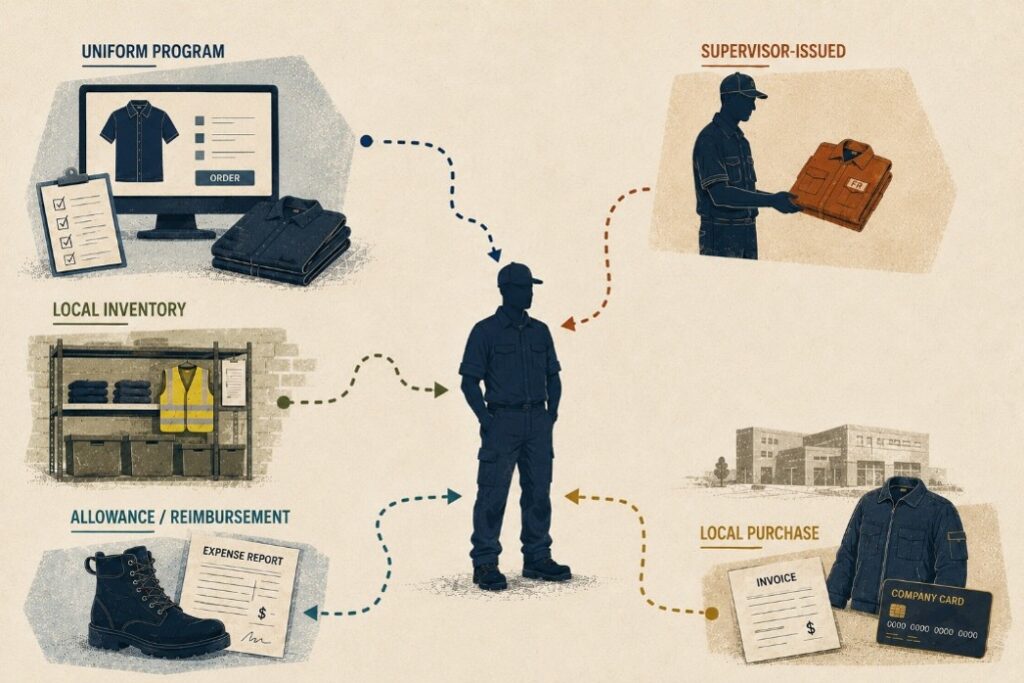
One employee’s workwear needs may be met through several separate ordering, issuance, inventory, reimbursement, and local purchasing processes.
Every one of those processes may work perfectly well on its own, but how many different ways can one employee obtain something they need to wear for work?
That may tell you more about fragmentation than simply counting vendors.
When Uniform Fragmentation Becomes a Safety-Apparel Issue
For standard branded apparel, an incorrect product may primarily create inconvenience and expense. For employees who require specialized protective apparel or footwear, product selection can have additional significance.
OSHA requires employers covered by its general-industry PPE requirements to assess workplace hazards, select appropriate types of PPE where necessary, communicate those selection decisions to affected employees and select PPE that properly fits them. OSHA also places responsibility on employers for assuring the adequacy of employee-owned protective equipment when employees provide their own.
Safety footwear provides a useful example. OSHA has specifically explained that an employer’s workplace hazard assessment can determine when safety-toe footwear is required.
Safety-related apparel and footwear can also have specific requirements based on the job and workplace hazards. ANSI/ISEA 107, for example, establishes performance requirements for high-visibility safety apparel.
That means a vest isn’t just any vest, and a work boot isn’t just any work boot.
The issue isn’t that decentralized purchasing automatically results in inappropriate products. The issue is control.
Can the organization readily determine which products are approved for which employees? Can managers and employees identify the appropriate products? Are purchasing practices consistent across locations? Can the organization verify what was actually provided?
The more specialized the workforce requirement, the more valuable consistent program controls can become.
Hidden Cost #6: The Cost You Can’t See
What did the organization actually spend last year to outfit its workforce?
The primary uniform supplier can report its sales, but what about FR garments purchased through another process? Safety footwear reimbursements? Purchasing-card transactions at individual locations? Rush freight? Locally held inventory? The employee time spent administering all of it?
Even if an organization knows what it spends with its primary uniform supplier, that may represent only part of what the program actually costs.
Without consolidated information, management may also have difficulty seeing where that money is going. How much is being spent by location, employee or department? Which products generate the most returns? Where are rush orders occurring? How much unused inventory is being carried? Are employee uniform allowances being used as intended?
Fragmentation can make it difficult not only to control costs, but to see them clearly in the first place.
The amount will be different for every organization. The important question isn’t whether these costs exist at some predetermined level. It’s whether the organization can identify and measure them.
An organization may not necessarily be paying too much for its uniforms. It may simply be paying more than it realizes to operate the system around them.
The Lowest Garment Price May Not Produce the Lowest-Cost Program
Product price matters. Organizations should negotiate competitive pricing and ensure they’re receiving appropriate value.
But consider a shirt available from another supplier for two dollars less. If obtaining that shirt also creates another purchase order, another invoice, another shipment, another approval path and another purchasing process to administer, has the organization actually saved two dollars?
Sometimes the answer will be yes; other times, no. The better measurement is total program cost.
Centralized Doesn’t Mean One-Size-Fits-All
There is an important distinction between standardizing a program and standardizing every employee.
A well-designed managed uniform program doesn’t require a driver, technician, warehouse employee, healthcare worker, supervisor and office employee to wear the same products.
Different employees often legitimately need different apparel based on job function, location, climate, gender, sizing, safety requirements, employee allowances or customer-facing responsibilities.
The objective is to centralize control and visibility while preserving the differences the workforce actually requires. Standardize the process where it makes sense. Customize the program where the workforce requires it.
What an Integrated Uniform Program Changes
The goal of integration isn’t simply to use fewer vendors. It’s to reduce unnecessary friction around outfitting employees.
Depending on the organization, a managed uniform program can bring together approved product catalogs, role-based access, employee allowances, approval workflows, decoration standards, safety apparel, footwear, inventory management, fulfillment, replacement programs and reporting.
That creates something individual transactions can’t provide: a view of the program as a whole.
Management can better understand what is being purchased, who is purchasing it, what employees are receiving and where money is being spent.
Employees get a clearer process for obtaining what they need. Managers spend less time solving routine uniform problems. Procurement gains greater visibility. Safety personnel can have greater confidence that approved products are being made available to the appropriate employees.
The organization hasn’t simply changed where it buys uniforms; it has changed how the program operates.
This Isn’t Only a Big-Company Problem
Fragmentation can become costly long before an organization employs thousands of people.
A smaller company may have several managers buying apparel independently. A regional organization may be managing different requirements across departments and locations. A large enterprise may face the same issues at much greater scale.
The economics change, but the fundamental management challenge does not.
The right program infrastructure should work whether an organization has dozens of uniformed employees or thousands. What changes is the scale—not the need for visibility, consistency and control.
How Fragmented Is Your Uniform Program?
A useful assessment doesn’t begin by counting uniform vendors.
Start by asking:
- How many different ways can an employee obtain something they need to wear for work?
- How many people or departments participate in ordering and administering the program?
- Can we determine our complete annual workforce apparel and footwear spend?
- Can we see spending by employee, department and location?
- Can employees easily determine what they’re eligible to order and how?
- Can management readily identify where the program is working—and where it isn’t?
If several of those questions are difficult to answer, the organization may have more fragmentation than it realizes.
Measure the Program, Not Just the Products
Organizations naturally pay attention to the cost of shirts, pants, jackets and work boots. They should, because the larger opportunity may be understanding what it costs to operate the system that puts those products on employees.
The objective isn’t necessarily to find the cheapest shirt, jacket or pair of safety boots. It’s to create a program that provides greater control over what the organization buys, what it spends, what employees receive and how the entire process operates.
Every organization is different. Its employees, locations, job requirements, safety needs, budgets and operating processes are different. Its workforce apparel program should be designed accordingly.
Is Your Uniform Program More Complicated Than It Needs to Be?
Feury Image Group helps organizations build managed uniform programs that improve visibility, simplify administration and bring greater control to the way employees are outfitted.
Frequently Asked Questions
What is a fragmented uniform program?
A fragmented uniform program uses multiple processes, departments, suppliers or purchasing methods to outfit employees without centralized visibility or control. For example, standard apparel may be ordered through one program while safety clothing, footwear, local inventory and employee reimbursements are handled separately.
What are the hidden costs of a uniform program?
Beyond the price of apparel and footwear, costs can include employee time spent administering the program, small-order freight and rush charges, returns and replacements, excess or obsolete inventory, reimbursements and the administrative work required to manage multiple purchasing processes.
This is firmly supported by the article’s treatment of administration, freight, returns and inventory.
How does uniform program fragmentation increase administrative costs?
A single uniform order can involve supervisors, administrators, managers, purchasing and accounting. When those activities are repeated across locations, new hires, replacements and multiple purchasing systems, relatively small tasks can accumulate into significant administrative work.
Does centralizing a uniform program mean every employee wears the same thing?
No. Centralization is about creating greater control and visibility, not making every employee wear identical products. Different roles may legitimately require different apparel based on job function, location, climate, sizing, safety requirements or customer-facing responsibilities.
How can an organization tell if its uniform program is too fragmented?
Look beyond the number of suppliers. Ask how many ways employees obtain work apparel, how many people administer the program, whether total annual spending can be determined, whether spending can be viewed by employee or location, and whether employees clearly understand what they are eligible to order.