
Growth doesn’t usually make uniform program management more difficult overnight. As organizations expand, new people, locations, approvals, vendors, and exceptions gradually transform what was once a simple purchasing task into an operational responsibility.
Most organizations don’t intentionally create complicated uniform programs. They begin with a straightforward process that works well for a single location or a smaller workforce. Then the business begins to grow.
A second location opens. New departments are added. Hiring accelerates. Different job functions require different apparel. Before long, a process that once required only occasional attention begins demanding regular oversight. The uniforms haven’t become more complicated, but the organization has.
At Feury Image Group, we’ve found that companies don’t struggle because they’re buying more apparel. They struggle because the simple processes that worked for a smaller organization no longer support the business they’ve become.
Growth Doesn’t Create Complexity All at Once
Complexity rarely arrives all at once. A new location begins ordering independently. A department develops its own approval process. Someone starts tracking orders in a spreadsheet because there isn’t another system available. Each decision makes sense at the time but over months or years, those independent decisions become disconnected processes that are increasingly difficult to manage consistently. That’s why organizations often don’t realize they’ve outgrown their uniform program until they begin asking questions that are surprisingly difficult to answer.
Every New Employee Adds More Than One Uniform
Adding employees creates new responsibilities that extend well beyond issuing apparel. Every new employee adds another series of responsibilities—onboarding, sizing, approvals, role-specific apparel, replacements, and budget tracking. Multiply that across multiple locations and departments, and uniform program management becomes far more than simply ordering apparel. The real challenge is managing the employee apparel lifecycle consistently.
More Locations Mean More Exceptions to Uniform Program Management
As organizations expand, standardization naturally becomes more difficult. One facility may require high-visibility apparel while another needs flame-resistant garments. Customer-facing employees often wear different apparel than warehouse or field personnel, and seasonal workers may follow different eligibility rules. Growth often introduces new brands as well. Acquisitions, new business units, regional identities, or customer-specific programs may require different logos, color palettes, or branded apparel. What was once a single-company uniform program can quickly become a multi-brand program that requires careful coordination to maintain consistency while supporting different business needs. Each difference makes sense. Together they create a growing number of exceptions that require coordination and consistent standards.

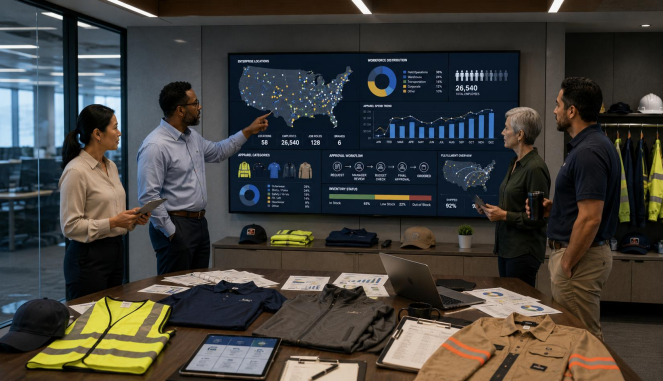
A centralized uniform program replaces disconnected vendors, approvals and order tracking with one organized system.
Communication Begins Replacing Process
One of the clearest signs that a program has become more complicated is the increasing amount of communication required just to keep it operating. As organizations grow, responsibility often settles on one person who already has another full-time job. That individual becomes the unofficial uniform manager—coordinating vendors, approving orders, answering employee questions, and resolving problems. Instead of relying on standardized processes, the organization begins relying on emails, spreadsheets, and individual knowledge. Every workaround adds administrative effort that quietly grows with the business.
Visibility Becomes More Valuable Than Ever
Leadership begins asking:
• Which locations are ordering the most?
• Where are replacement costs increasing?
• Are budgets being followed consistently?
Most organizations have much of this information somewhere, but it’s often spread across vendors, invoices, spreadsheets, emails, and individual departments rather than being available through one consistent program. Without visibility, decision-making becomes reactive instead of strategic. Organizations that consolidate fragmented purchasing and introduce standardized program management often discover meaningful savings—not because they purchase lower-quality apparel, but because they eliminate duplication, improve purchasing visibility, and reduce administrative inefficiencies.
BUILT AROUND YOU™ INSIGHT
Growth doesn’t create administrative burden.
It exposes processes that no longer scale.
Better Structure Supports Better Uniform Program Management Growth
The answer isn’t creating more policies or adding additional administrative work. It’s building a program designed to support a larger organization. Modern managed uniform programs provide standardized ordering, approval workflows, reporting, budget controls, and coordinated fulfillment that continue working as organizations evolve. The strongest programs aren’t built only for today’s organization. They’re designed to adapt as businesses grow, acquire companies, add brands, or expand into new markets. A well-managed program provides enough structure to maintain consistency while remaining flexible enough to adapt as the business changes.
Rather than depending on individual managers to remember procedures, the program itself provides the consistency needed to allow organizations to spend less time managing apparel and more time supporting employees and serving customers.
A Better Question to Ask About Uniform Program Management
Instead of asking: “How do we manage all of these uniform requests?” Ask: “Is our uniform program designed to support the organization we’ve become—and the one we’re continuing to build?” Organizations rarely outgrow their uniforms. They outgrow the informal processes that once made managing those uniforms seem simple. At Feury Image Group, we believe the strongest uniform programs aren’t measured by the garments they provide. They’re measured by how consistently they support the people, processes, and operations behind a growing organization. Better-managed uniform programs improve consistency, reduce administrative effort, increase purchasing visibility, and often uncover measurable cost savings. The result isn’t simply a better apparel program—it’s uniform program management better aligned with the way the organization operates.
Key Takeaway
Organizations rarely outgrow their uniforms. They outgrow the processes that once made managing
those uniforms simple.
Expert Insight
“Growth isn’t what makes uniform programs difficult. Growth simply exposes the point where informal
processes stop supporting the business. The organizations that continue to operate efficiently are the
ones that build systems designed to scale.”
— Ken Yanicky, Vice President
Continue the Built Around You Series
If your organization is experiencing similar challenges, other articles in the series explore related topics:
• 5 Signs Your Company Has Outgrown Its Uniform Program
• Why Workforce Programs Should Be Designed, Not Purchased
• Managing Multi-Location Uniform Programs
• Customization Without Complexity
• Uniform Rental vs. Direct Purchase
Built Around Your Organization
Every organization grows differently. The strongest workforce apparel programs are designed to grow with them. Feury Image Group helps organizations build managed uniform programs that improve consistency, simplify administration, increase purchasing visibility, and support long-term operational growth.
Feury Image Group
973.465.0900
[email protected]