
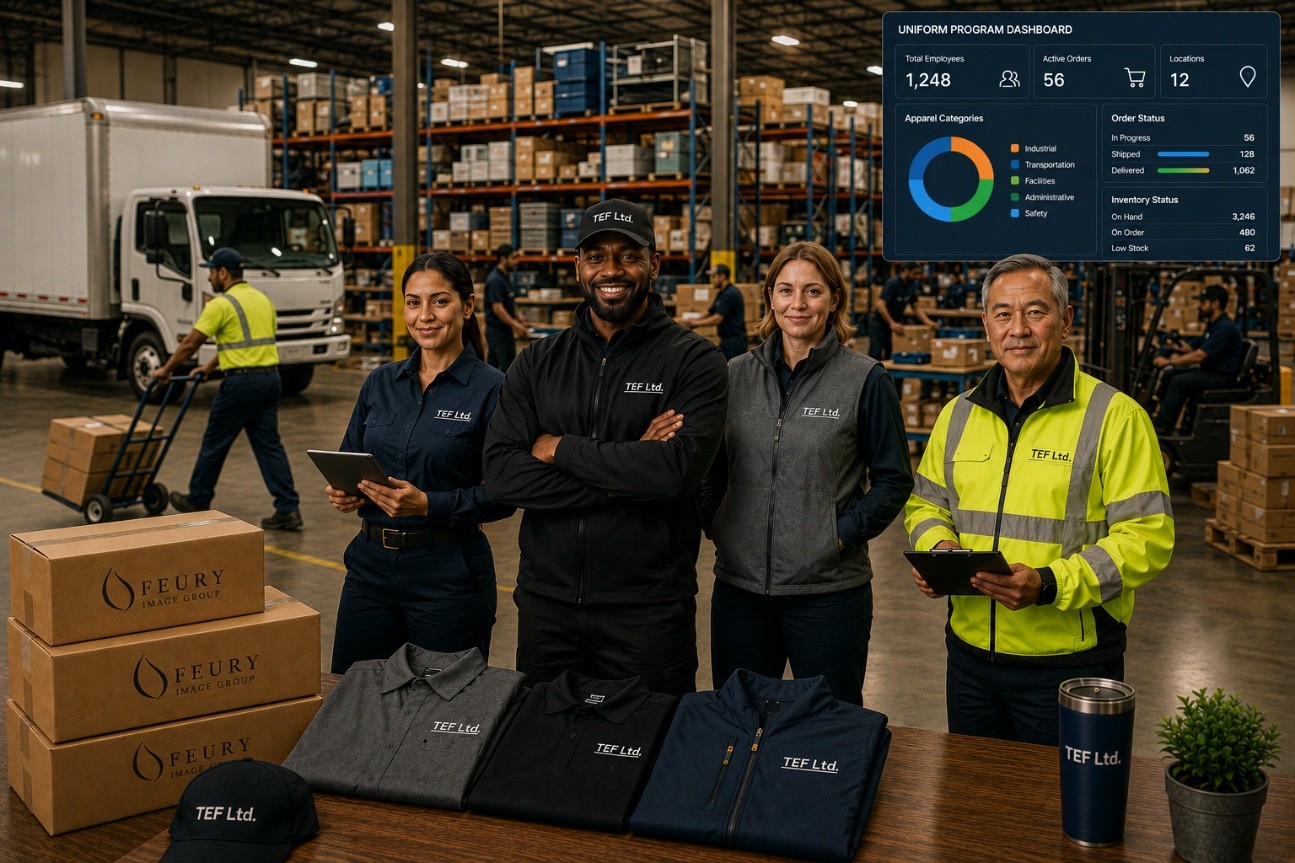
Today, businesses are experiencing increasing pressure on numerous fronts: control costs, improve employee experience, strengthen brand consistency, and operate more efficiently across multiple departments and locations. As a result, many procurement leaders, operations teams, and HR departments are taking a fresh look at uniform rental vs purchase programs and whether traditional rental programs still align with modern business needs.
Increasingly, the answer is no.
For decades, uniform rental programs were often viewed as the default solution for outfitting employees. Weekly service routes, bundled laundering, and standardized garments created a system that felt predictable, especially for industrial and service-oriented businesses. But the way businesses operate has changed.
Across industries, including manufacturing, transportation, utilities, healthcare, facilities management, and construction, more organizations are exploring managed direct-purchase uniform programs as a more flexible and transparent alternative.
Today, the uniform rental vs purchase decision increasingly affects operational visibility, employee experience, and long-term cost control. And for many companies, the shift is becoming part of a broader modernization strategy.
Why Businesses Originally Chose Uniform Rental
In the past, rental programs solved legitimate operational challenges for many companies.
Historically, rental providers offered:
- Weekly laundering service
- Garment repair and replacement
- Consistent employee outfitting
- Simplified administration
- Predictable recurring service
- Reduced need for internal inventory management
For organizations without any internal infrastructure or apparel expertise, rental often seemed like the easiest path forward.
In certain industrial environments, such as those involving grease, industrial soils, or hazardous contaminants, laundering services remain necessary and valuable. However, some organizations have raised concerns about how shared industrial laundering systems process garments from multiple customers and contamination levels within the same operational stream. Depending on the application, businesses may prefer greater control over garment handling, replacement cycles, and contamination management procedures.
But many companies today are discovering that what once felt convenient can eventually become restrictive, expensive, and difficult to scale.
The Shift Toward Greater Visibility and Control
Modern operations teams expect more visibility into every area of the business.
They can track fleet vehicles in real time. Monitor inventory levels instantly. Review purchasing analytics on demand. Automate approvals across departments and locations.
Yet many traditional rental programs still operate with limited transparency.
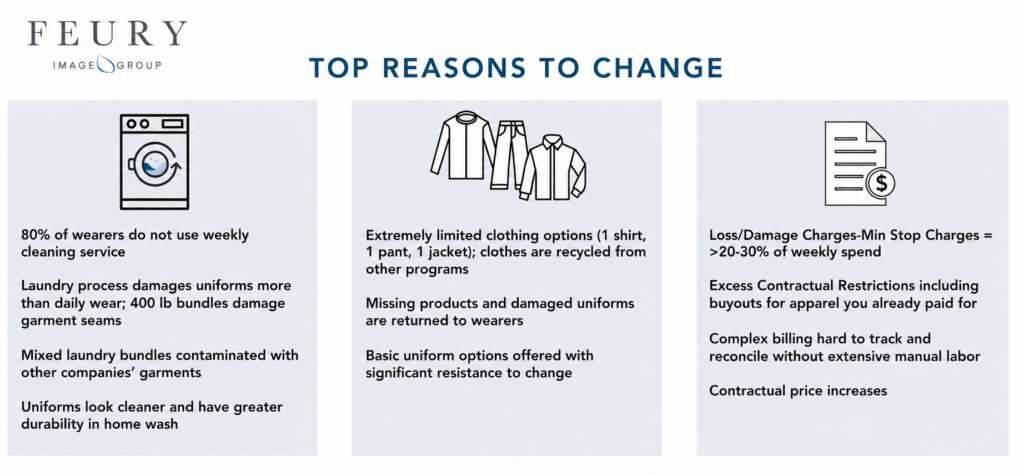
Organizations increasingly reevaluate rental programs due to operational limitations, hidden costs, and reduced flexibility.
Common frustrations businesses express include:
- Difficulty understanding invoice fluctuations
- Charges tied to former employees
- Paying for garments not actively worn
- Limited visibility into inventory allocation
- Inconsistent branding across locations
- Long replacement cycles
- Restrictions on garment customization
- Contract structures that feel difficult to exit
For multi-location organizations in particular, these issues can compound quickly.
What begins as a simple weekly service relationship can evolve into a fragmented system that lacks flexibility and operational clarity.
That is one reason many businesses are now evaluating direct-purchase managed programs designed around modern operational expectations.
Understanding the Cost Conversation
For many organizations evaluating uniform rental vs purchase options, long-term visibility matters more than short-term convenience. Cost is often the first reason businesses begin evaluating alternatives to rental programs. Rental programs can initially appear attractive because costs are distributed weekly rather than purchased upfront.
However, over time, businesses often discover recurring expenses tied to:
- ongoing service charges
- repair fees
- replacement fees
- delivery fees
- administrative charges
- size-related surcharges
- underutilized inventory
- inactive employee accounts
- contract escalators
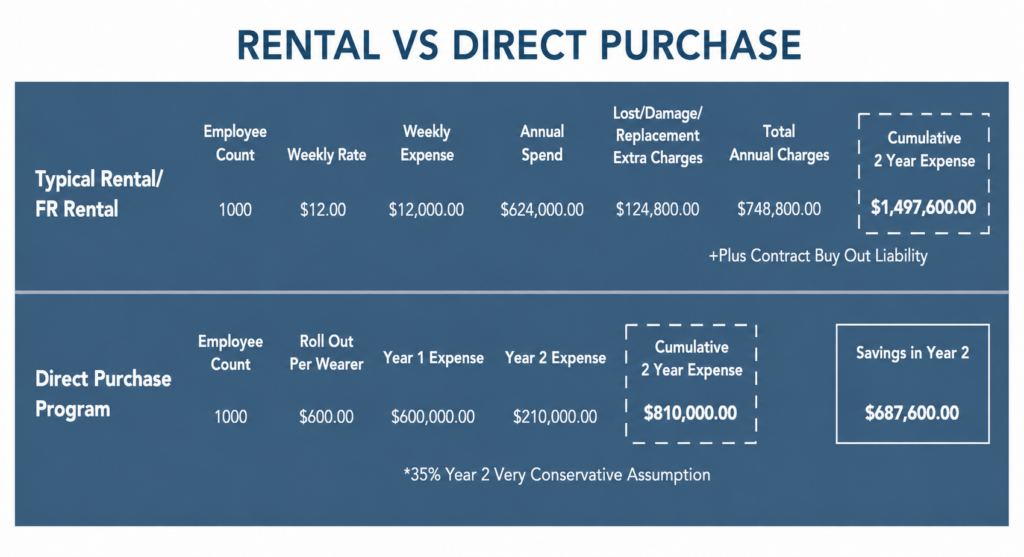
A visual comparison of uniform rental vs. purchase program costs over time, showing the operational and financial differences between traditional rental FR programs and direct purchase uniform strategies.
For organizations with large employee populations or multiple locations, these recurring costs can become difficult to forecast clearly.
A managed purchase program shifts the conversation toward ownership and lifecycle management. Instead of continuously renting garments indefinitely, businesses invest in apparel assets with defined replacement schedules and greater purchasing visibility.
This can allows organizations to:
- reduce long-term spend
- standardize purchasing
- improve garment quality
- control replacement timing
- align apparel investment with budgeting cycles
- reduce operational waste
Most importantly, leadership gains greater clarity into where uniform dollars are actually going.
Uniform Rental vs Purchase: The Real Operational Difference
At the surface level, rental and purchase programs may appear similar. Employees receive uniforms. Branding is applied. Apparel is distributed.
But operationally, the models function very differently.
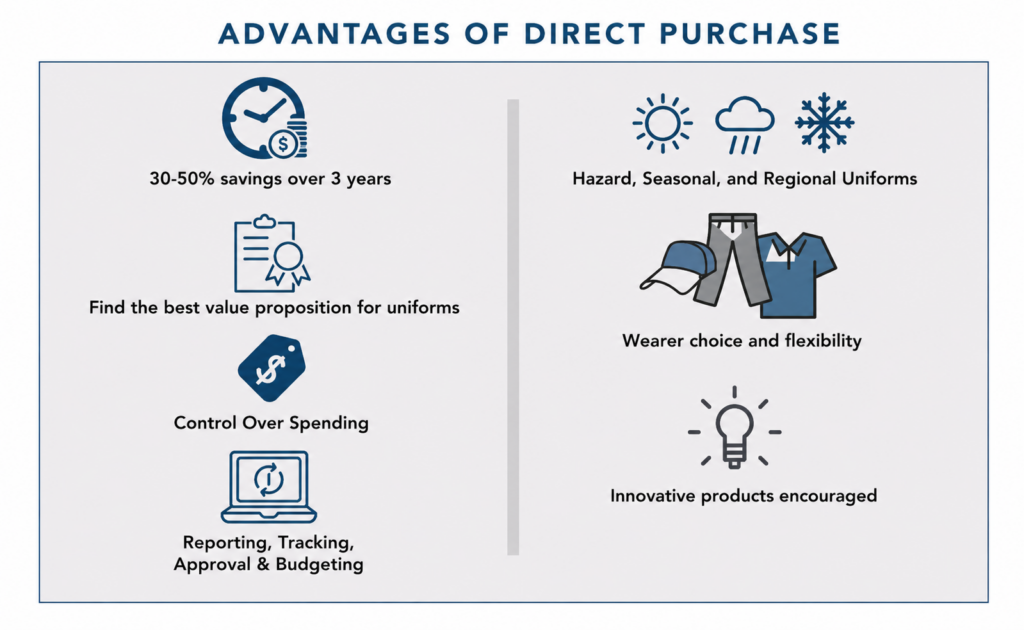
Modern direct purchase programs provide organizations with greater control, flexibility, reporting visibility, and long-term cost advantages.
Rental Programs
In a rental environment:
- garments are typically owned by the provider
- inventory remains controlled externally
- weekly recurring charges continue indefinitely
- garment selection may be limited
- replacement timelines may depend on their route cycles
- branding and customization options can be limited
The business is essentially participating in a long-term service agreement tied to apparel usage.
Direct-Purchase Managed Programs
In a managed purchase model:
- the organization owns its apparel
- garments can be selected based on role, environment, and employee preference
- branding standards are controlled internally
- ordering can be centralized digitally
- inventory can be warehoused and refilled strategically
- departments and locations can operate within customized rules and budgets
This approach increasingly aligns with how companies manage other operational assets with greater flexibility, reporting, and long-term control.
The Employee Experience Factor
One of the newest drivers behind uniform program changes today is employee satisfaction.
Modern workers expect apparel that feels more comfortable, contemporary, and role-appropriate than the industrial garments commonly associated with older rental systems.
This matters more than many organizations realize. Employees increasingly view uniforms as part of their daily work experience and not simply a compliance requirement.
Businesses are responding by prioritizing:
- better fitting garments
- modern styling
- lightweight performance fabrics
- weather-specific layering
- gender-inclusive options
- role-specific outfitting
- premium outerwear
- improved footwear integration
- personalization and embroidery
Organizations competing for talent understand that apparel impacts employee perception, morale, and retention. Dated or uncomfortable uniforms can unintentionally communicate that employee experience is not a priority.
Modern managed purchase programs allow organizations to evolve apparel selections more easily while maintaining consistent brand standards.
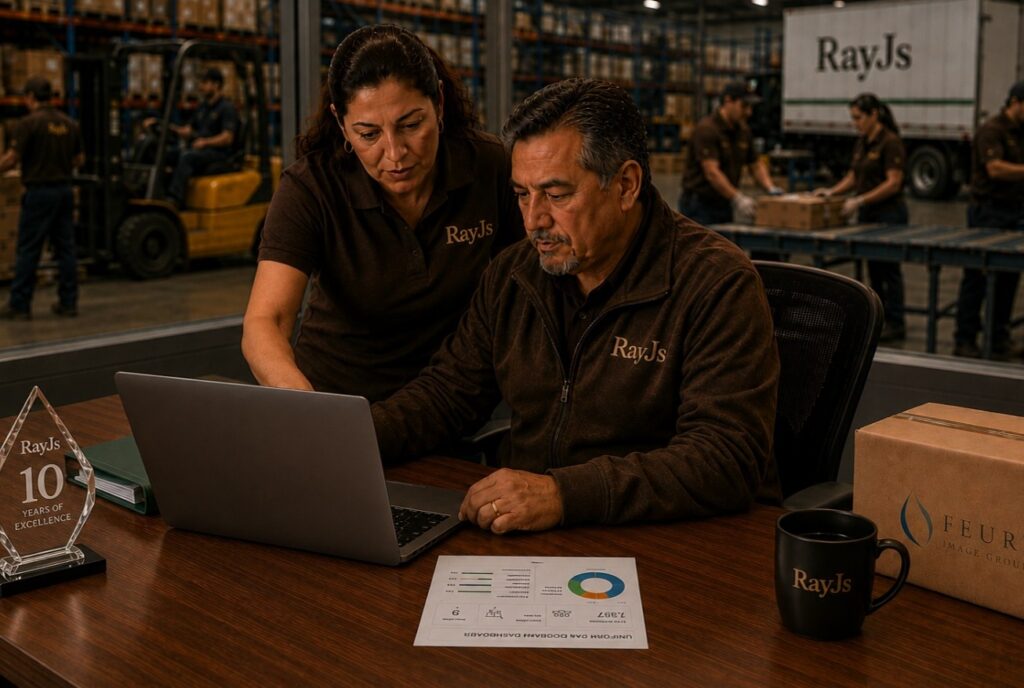
Modern workforce apparel programs combine branding, fulfillment, technology, and operational visibility across complex organizations.
Multi-Location Organizations Face Unique Challenges
The larger and more distributed an organization becomes, the more complicated uniform management can get.
Different departments often require:
- different garments
- different branding treatments
- different safety requirements
- different approval structures
- different budgets
- different fulfillment needs
Traditional rental systems were not designed for this level of operational complexity.
As organizations scale, procurement and operations teams frequently encounter challenges such as:
- inconsistent apparel between locations
- lack of centralized reporting
- duplicate vendor relationships
- inconsistent employee onboarding
- delays in outfitting new hires
- poor inventory forecasting
This is where managed uniform platforms have become increasingly important.
Modern programs can support:
- role-based apparel assignment
- employee allowances
- approval workflows
- department-specific catalogs
- centralized reporting
- inventory tracking
- multi-location distribution
- home delivery or facility delivery
- branded consistency across regions
The goal is not simply to supply garments, but to create a scalable operational system.
Technology Is Changing Uniform Program Expectations
One of the biggest differences between older rental models and modern managed apparel programs is technology. Organizations increasingly expect uniform management systems to function similarly to other enterprise procurement platforms.
That includes:
- web-based ordering portals
- role-based permissions
- approval routing
- employee allotments
- reporting dashboards
- location hierarchy management
- centralized purchasing controls
- reorder automation
For HR and operations teams, these tools can dramatically reduce administrative burden while improving visibility.
For employees, it creates a smoother onboarding and ordering experience. For leadership, it provides measurable operational insight.
In many cases, businesses are not simply leaving rental because of garments. They are leaving because they want a more modern operational framework.
Case Study: Leaving Rental Behind
One manufacturer recently partnered with Feury Image Group to transition away from a traditional rental program after experiencing ongoing concerns around cost visibility, garment consistency, and operational flexibility.
The organization wanted:
- improved apparel quality
- better employee-specific organization
- stronger branding consistency
- more efficient distribution
- greater cost control
The result was a managed apparel solution featuring individually packed employee orders, customized branding applications, organized distribution, and a more modern employee experience.
The transition also created better operational visibility while reducing many of the frustrations associated with the prior rental structure.
View the Case Study:
A Seamless Exit From Uniform Rental
Uniform Programs Are Becoming Part of Brand Strategy
Uniforms are no longer viewed solely as operational necessities. They are increasingly part of how organizations communicate professionalism, safety culture, consistency, and brand identity.
This is especially important for:
- customer-facing employees
- transportation teams
- healthcare workers
- utility crews
- facilities personnel
- field service technicians
- multi-site operations
Modern apparel programs allow businesses to align uniforms more closely with company culture and brand standards while still maintaining operational practicality.
That includes:
- premium embroidery
- reflective striping applications
- outerwear coordination
- branded PPE integration
- department differentiation
- anniversary recognition
- leadership identifiers
- modern retail-inspired styling
The result is often a workforce that looks more unified, professional, and aligned with the company’s image.
Is Rental Still Right for Some Businesses?
It can be.
Certain industries and environments may still benefit from rental-based laundering programs, particularly when garments are heavily exposed to industrial contaminants or require specialized cleaning protocols.
However, for many organizations taking the time to evaluate what uniform system best suits their needs for today and tomorrow, the answer has changed, especially as organizations prioritize:
- operational flexibility
- employee experience
- digital visibility
- procurement control
- scalable infrastructure
- branding consistency
- long-term cost management
Built Around the Way Modern Organizations Operate
At Feury Image Group, we work with organizations that increasingly want more than a traditional uniform vendor relationship.
They want programs built around how their business actually operates. That may include:
- centralized ordering portals
- customized approval structures
- warehousing and inventory management
- employee-specific fulfillment
- multi-location coordination
- branded apparel customization
- onboarding support
- reporting visibility
- scalable apparel strategies
The uniform rental vs purchase conversation has become part of a much larger operational modernization discussion. The objective is not simply supplying garments, it is building a uniform program designed around operational realities, employee needs, and long-term business goals.
Because today, the most effective uniform programs are not one-size-fits-all.
They are built around you.
Continue the Built Around You Series
Built Around You is an ongoing Feury Image Group thought leadership series exploring workforce visibility, operational consistency, safety, branding, and apparel program management.
- Managing workforce consistency across locations, departments, and operational environments:
Managing Uniform Programs for Multi-Location Organizations - How customization impacts morale, identification, and consistency:
Customization and Personalization of Uniforms - The relationship between workwear and employee engagement:
Workwear, Employee Performance, and Engagement - Building high-visibility programs that function in real operations:
High-Visibility Safety Apparel Programs That Work
FAQs: Uniform Rental vs Purchase Programs
What is the difference between a uniform rental program and a direct-purchase program?
A uniform rental program typically involves recurring service fees where garments remain owned and managed by the provider. A direct-purchase program allows the business to own its uniforms while managing ordering, branding, replacement, and distribution through a structured apparel program.
Why are companies moving away from traditional uniform rental programs?
Many organizations are seeking greater visibility into costs, more flexibility in apparel choices, improved employee comfort, stronger branding consistency, and better operational control. Businesses are also modernizing uniform management through digital ordering platforms and centralized reporting tools.
Are direct-purchase uniform programs more cost-effective?
For many organizations, direct-purchase programs can provide better long-term cost visibility and control. Instead of ongoing recurring rental charges, businesses invest in owned apparel assets with planned replacement cycles and customizable inventory management.
Can managed purchase programs still include inventory management and employee fulfillment?
Yes. Modern managed uniform programs can include warehousing, employee-specific fulfillment, role-based ordering, inventory tracking, approval workflows, and multi-location distribution support.
Are rental programs still beneficial in some industries?
Yes. Certain environments involving heavy industrial soils, hazardous contaminants, or specialized laundering requirements may still benefit from rental-based laundering services. The best solution depends on operational needs, compliance requirements, and workforce structure.
How do modern uniform programs improve employee experience?
Modern programs allow businesses to offer more comfortable fabrics, better garment fit, weather-specific apparel, premium outerwear, gender-inclusive options, and role-specific customization — helping employees feel more professional and supported.
What are the advantages of ownership in a uniform program?
Owning uniforms can provide greater control over branding, inventory, replacement timing, apparel quality, customization, and budgeting. It also allows organizations to adapt programs more easily as operations evolve.
Is a uniform rental vs purchase strategy better for multi-location organizations?
Modern apparel platforms can centralize ordering, approvals, reporting, employee allowances, branding standards, and inventory visibility across multiple facilities, departments, and geographic regions.
Can a managed uniform program integrate with onboarding and employee allocation systems?
Yes. Many modern programs support employee onboarding workflows, annual allowances, department budgets, approval structures, and automated ordering processes through web-based platforms.
What industries benefit most from managed direct-purchase apparel programs?
Industries commonly using managed purchase programs include manufacturing, transportation, utilities, healthcare, facilities management, construction, education, municipalities, and field service organizations.
How does branding differ between rental and managed purchase programs?
Managed purchase programs often provide greater flexibility for embroidery, personalization, outerwear coordination, reflective applications, department identification, and retail-inspired apparel styling while maintaining consistent brand standards.
What should businesses evaluate before changing uniform providers?
Organizations should review:
- total program costs
- contract flexibility
- employee satisfaction
- garment quality
- branding consistency
- technology capabilities
- reporting visibility
- onboarding efficiency
- inventory management
- scalability across locations and departments