
When Organizations Design Their Workforce Apparel Program, They Should Start With the Organization, Not the Uniform
When evaluating a workforce apparel program, the conversation often starts with products.
What shirts do we want? Which pants? What colors? Which brands? What should the logo look like?
Those questions matter. But they come later.
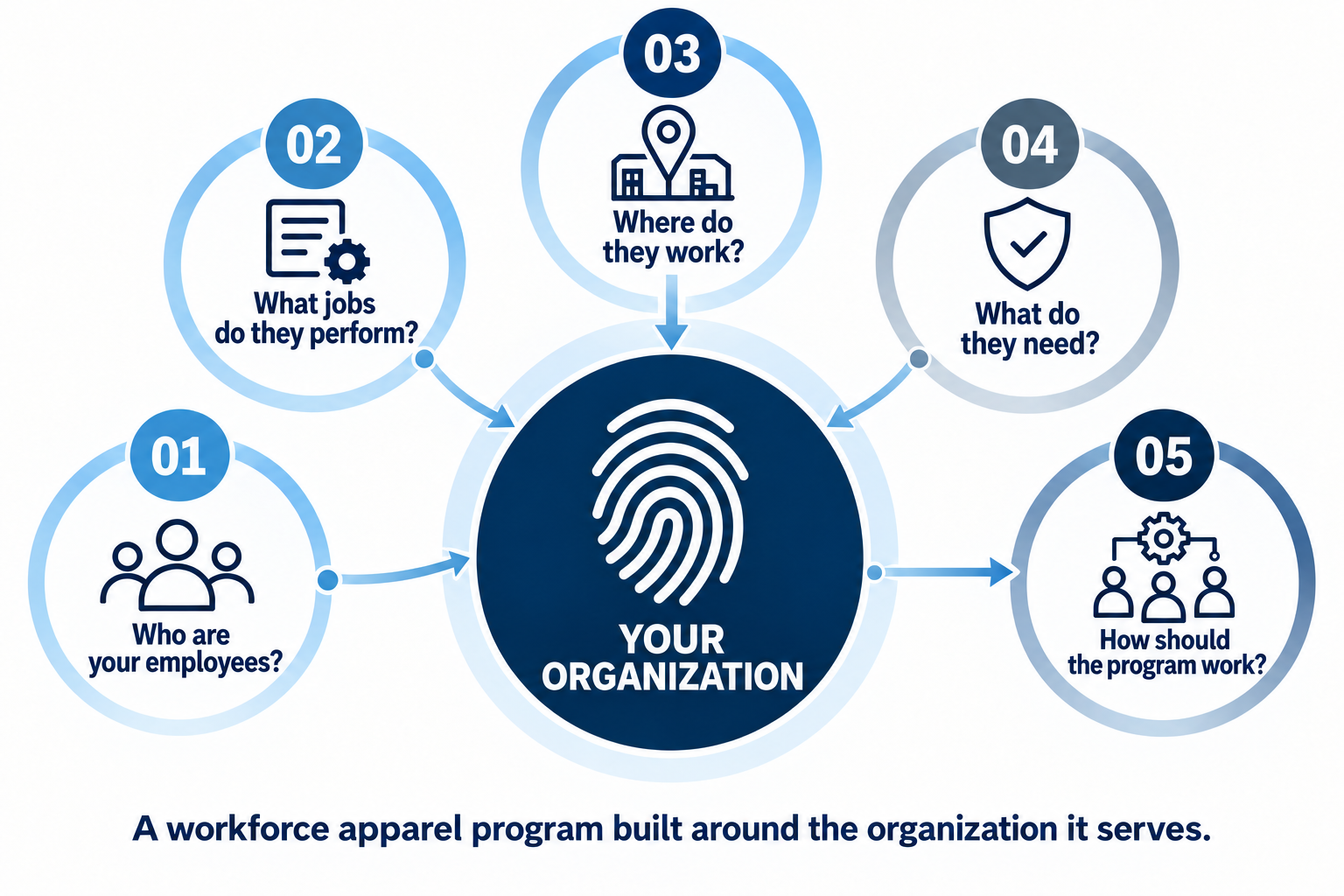
A successful workforce apparel program begins with a different set of questions:
Who are your employees? What jobs do they perform? Where do they work? What do they need to do those jobs safely and effectively? How do you want apparel ordered, approved, distributed, and managed?
The answers can vary considerably from one organization to another—and even among employees within the same organization.
A field tech may need flame-resistant or high-visibility apparel. A customer-facing employee may need a polished, branded look. Employees working outdoors in New England have different seasonal needs from employees doing the same jobs in Florida.
Then there are the operational differences. One organization may provide each employee with an annual allotment. Another may allocate apparel by department. Some require manager approval for certain purchases. Others need employees to order from role-specific catalogs.
A workforce apparel program also touches multiple parts of an organization. Operations, safety, human resources, procurement, finance, and marketing each bring different requirements—from equipping employees safely and consistently to controlling spending and protecting the brand.
Those requirements should help shape the program before apparel is selected.
An effective workforce apparel program should be built around the organization it serves.
Begin With the People Doing the Work
A workforce apparel program ultimately succeeds or fails with the person wearing the apparel. That makes the job itself a logical starting point.
What does the employee actually do during a normal workday?
Consider:
- The physical demands of the job
- Work environment and climate
- Visibility or other safety requirements
- Customer interaction
- Required tools or equipment
- Movement and range of motion
- Fit and sizing needs
- How frequently garments are worn and replaced
For some jobs, these considerations are primarily about comfort, durability and appearance. For others, apparel is connected directly to workplace safety.
OSHA’s general-industry PPE standard requires employers to assess the workplace for hazards, select PPE that protects employees from identified hazards, and select PPE that properly fits each affected employee. OSHA guidance also emphasizes comfort and fit, noting that poorly fitting PPE may not provide the necessary protection.
Those principles extend beyond regulated PPE.
Apparel should fit the job, the environment, and the employee—not simply the purchasing process.
The objective should be consistency where consistency makes sense, with appropriate differences where job requirements demand them.
Design the Workforce Apparel Program Around Roles, Not Just Departments
Once employee and job needs are understood, they can be translated into role-specific apparel choices.
Many organizations initially organize apparel by department: Operations gets one assortment, Facilities another, Sales another. That can work, but departments don’t always tell the whole story. Within a single department, employees may perform very different jobs.
A transportation organization, for example, might have drivers, supervisors, maintenance employees, safety personnel and trainers. A healthcare organization might need to accommodate clinical staff, laboratory employees, facilities teams, food service employees and administrative personnel.
The more useful question is:
What should this employee be able to order based on the work he or she performs?
A role-based approach can determine:
- Which garments an employee can access
- Which safety classifications are required
- What colors or branding apply
- How many items the employee is eligible to receive
- Which footwear or outerwear is appropriate
- Which purchases require approval
- How often items can be replaced
This turns an apparel catalog into something more useful: a controlled program tailored to the workforce.
Safety Requirements Should Be Designed Into Your Workforce Apparel Program
For organizations with safety-sensitive jobs, apparel decisions cannot be separated from the work environment.
High-visibility apparel provides a straightforward example. ANSI/ISEA 107 establishes design, testing, performance, and labeling criteria for high-visibility safety apparel. Garments are classified according to expected use settings and performance requirements.
High-visibility requirements vary by job and work environment.
The same principle applies when evaluating flame-resistant and arc-rated apparel, protective footwear and other job-specific equipment.
Requirements should be identified by job function and work environment and translated into the apparel choices available to employees—not left to employees or managers to determine from a broad catalog.
A properly designed program can make the right choice the easy choice.
Fit Is a Program Issue, Not Just a Garment Issue
Providing more sizes does not, by itself, solve fit. Employees differ in height, body shape and proportions. Men’s and women’s fits differ, manufacturers size garments differently, and footwear introduces another level of complexity.
Proper fit matters to safety as well as comfort. OSHA notes that poorly fitting PPE may not provide the necessary protection.[2]
Depending on the workforce, a program might provide broader size ranges, men’s and women’s styles, multiple approved garment options, fittings or samples, clear sizing information and defined exchange procedures.
The objective isn’t unlimited choice. It is appropriate choice—enough flexibility to meet the needs of the workforce while maintaining program standards.
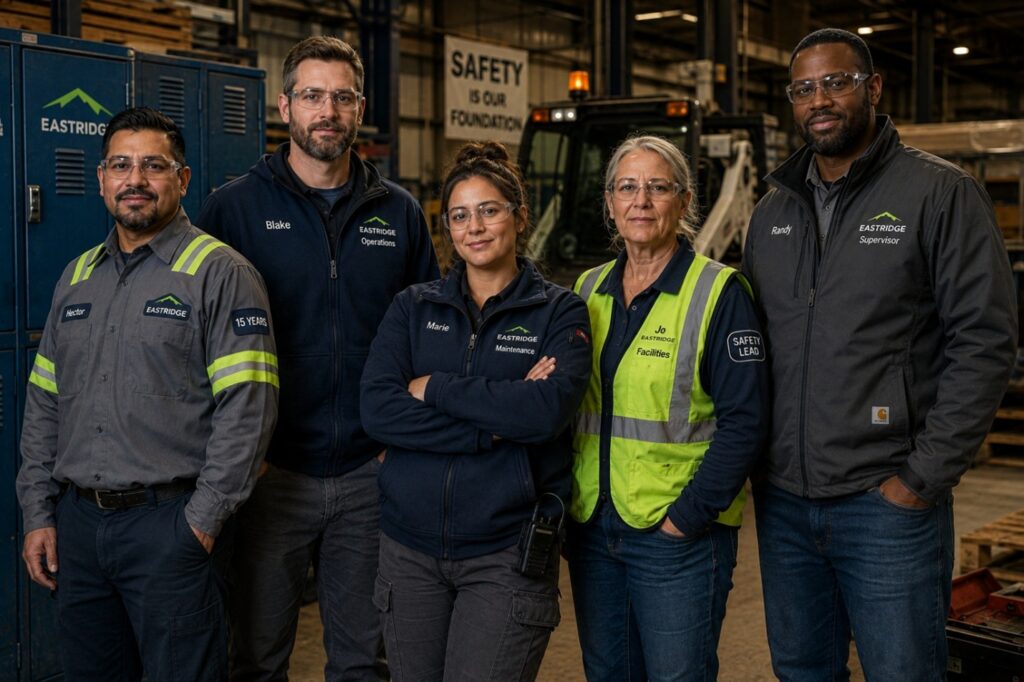
Customized workwear programs help organizations recognize employees while improving professionalism, team identity, and operational consistency.
Build the Business Rules Into the Workforce Apparel Program
Once employee and job requirements have been established, the next question is how the organization wants the program to operate. This is where a workforce apparel program becomes an operating system rather than a product list.
Consider the rules that may need to be established:
Eligibility. Who receives company-provided apparel?
Allotments. How much can each employee order, and how frequently?
Approvals. Which purchases can employees make independently and which require authorization?
Catalog access. Should everyone see every product, or only products approved for their role?
Replacement. How are damaged, worn or lost items handled?
New hires. How quickly can new employees be outfitted?
Branding. Which logos, colors and decoration methods apply to different groups?
Budgeting. Is spending controlled by employee, department, location, job class or cost center?
Reporting. What information do managers, procurement and finance need to see?
These are organizational decisions. Technology can help administer them, but technology shouldn’t determine what the rules are.
Technology Should Support the Organization—Not the Other Way Around
An online ordering portal can simplify workforce apparel management considerably. But a portal is only as effective as the program logic behind it. A well-designed system can present employees with approved assortments, manage allotments, route orders for approval, apply location or department rules, and provide reporting to management. It can also remove decisions employees and managers shouldn’t have to make.
A worker shouldn’t have to sort through dozens of irrelevant options to find the correct apparel. A manager shouldn’t have to remember each employee’s annual allowance. Procurement shouldn’t have to reconstruct purchasing activity from multiple invoices and spreadsheets.
The technology should reflect decisions already made about how the organization wants its program to work.
A business shouldn’t have to change its processes simply because its apparel system can’t accommodate them.
Distribution Is Part of the Design
Ordering is only half the process. The apparel still has to reach the employee.
For a multi-location or distributed workforce, employees may work from offices, hospitals, warehouses, construction sites, customer locations, vehicles or remote facilities. Some work traditional shifts; others may work overnight or around the clock.
The program therefore needs to answer another fundamental question: What is the most practical way for employees to receive what they need?
Depending on the organization, that might include shipment to a central location or individual facilities, direct-to-employee delivery, on-site distribution, scheduled fitting events, secure pickup locations, or automated lockers or vending solutions.
Distribution shouldn’t be something to solve after the ordering system is established.
A program that makes ordering easy but receiving difficult has solved only half the problem.
Standardization Doesn’t Mean One Size Fits All
An organization can establish common standards for branding, safety, purchasing and reporting while allowing appropriate variation by job, location and employee need.
The goal is central control without forcing every employee into an identical solution. That helps avoid two extremes: a fragmented program in which locations or departments operate independently, and an overly rigid program that ignores legitimate differences across the workforce.
Employee Input Has a Place in Program Design
Designing around the organization also means listening to the people who will actually wear the apparel.
Employees understand things about their jobs that may not be obvious from a job description. They know where a pocket interferes with equipment, whether a fabric becomes uncomfortable during a long shift, whether outerwear provides enough mobility or whether footwear is practical for the surfaces on which they work.
NIOSH’s Total Worker Health framework identifies worker engagement in program design and implementation as an important element of efforts to advance worker safety, health, and well-being.
That doesn’t mean apparel decisions should be made by employee vote. It means the people doing the work can provide useful information before decisions become program standards.
Pilot programs, wear tests, fittings, and structured employee feedback can help identify problems before apparel is deployed across hundreds or thousands of employees.
Design for the Organization You Are Becoming
A workforce apparel program shouldn’t only work on launch day. Organizations change. They open locations, add job classifications, acquire businesses, introduce new branding, change safety procedures and hire employees in new regions.
A program that works for 100 employees may become increasingly difficult to manage at 500 or 5,000.
That makes scalability part of program design:
- Can new locations and job roles be added efficiently?
- Can eligibility rules change as needs change?
- Can spending be tracked across locations?
- Can new employees be outfitted efficiently?
- Can the organization maintain standards as it grows?
A program designed around the organization today should also be capable of adapting to the organization it becomes tomorrow.
Ask a Better Question About Your Workforce Apparel Program
When organizations begin reviewing workforce apparel, the natural question is:
What uniforms should we buy?
There is a better place to start:
What does our organization need its workforce apparel program to accomplish?
That question shifts the focus from products to requirements—and ultimately leads to a workforce apparel program designed around the organization, rather than an organization forced to work around its uniform program.
BUILT AROUND YOU™ INSIGHT
A workforce apparel program shouldn’t determine how your organization operates.
The way your organization operates should determine how the program is designed.
The right products matter, but so do the systems that determine who receives them, how they’re selected, how they’re ordered, how they’re distributed and how the program is managed.
When those pieces are designed together, workforce apparel becomes more than something employees wear.
It becomes part of how the organization works.
A QUICK SELF-ASSESSMENT
Is Your Workforce Apparel Program Built Around Your Organization?
Ask yourself:
□ Are apparel choices based on specific job requirements?
□ Do employees have access to products appropriate for their roles?
□ Are safety and compliance requirements built into product selection?
□ Does the program accommodate different sizes, fits and employee needs?
□ Are allotments, eligibility and approval rules clearly defined?
□ Does your ordering technology reflect the way your organization actually operates?
□ Is distribution designed around where and when employees work?
□ Can new employees, roles and locations be added efficiently without losing program control?
□ Do employees have a structured way to provide feedback on fit and performance?
If several of these questions are difficult to answer, the issue may not be the apparel. It may be the way the program was designed.
READY TO BUILD A PROGRAM AROUND YOUR ORGANIZATION?
Feury Image Group helps organizations develop workforce apparel programs around their people, operational requirements, and business goals—from product selection and program rules to ordering, distribution, and reporting.
Let’s talk about what a program built around your organization could look like.