
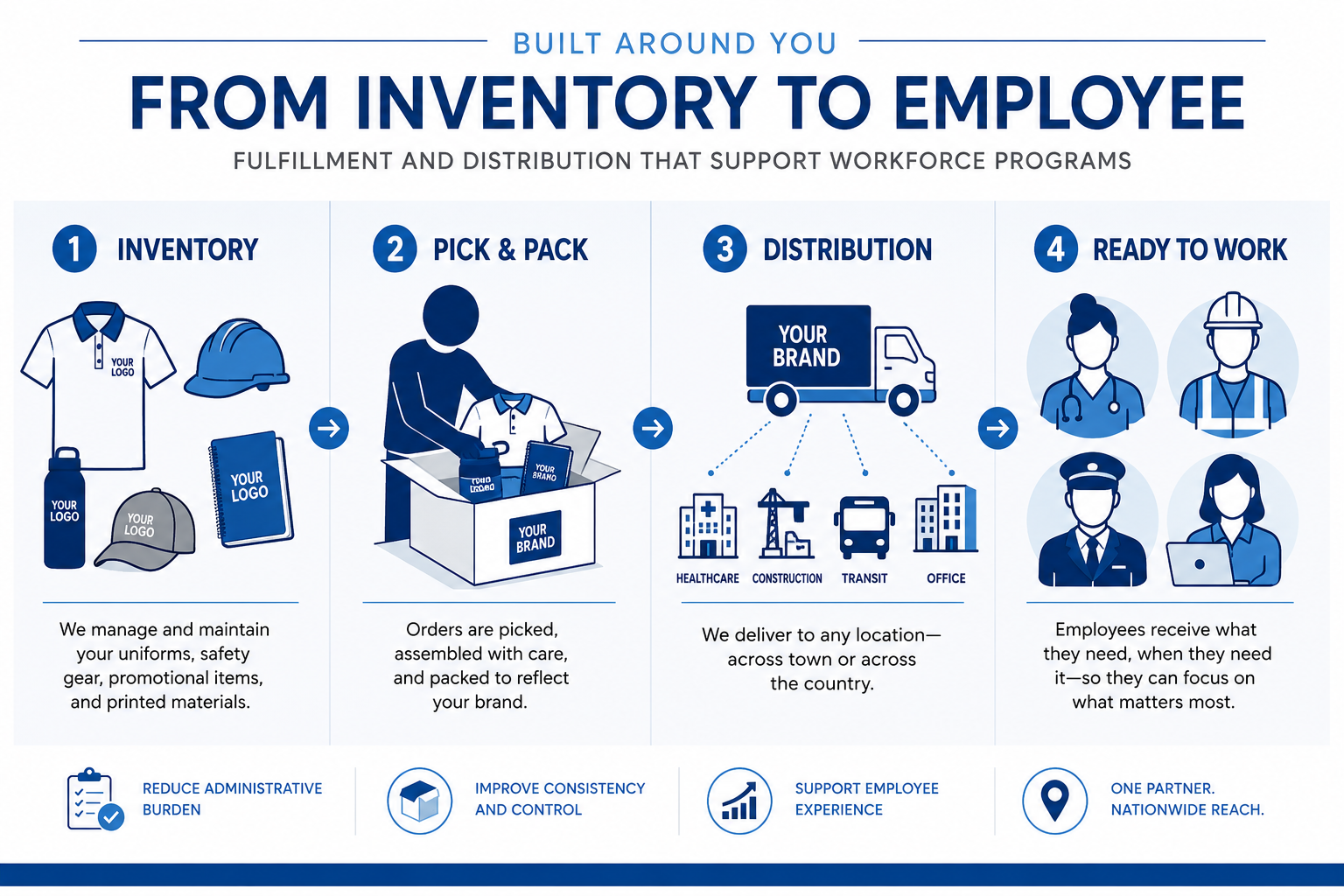
How Fulfillment, Distribution, and Inventory Support Stronger Workforce, Branding, and Operational Programs
For many organizations, the challenge around fulfillment and distribution for workforce programs isn’t about obtaining the products, uniforms, promotional items, printed materials, or safety equipment they need. The challenge is getting the right items to the right employees, locations, and customers—consistently and efficiently.
As organizations grow, distribution often becomes one of the most overlooked operational bottlenecks. Multiple locations. Remote employees. Field teams. New hires. Seasonal workers. Event materials. Marketing campaigns. Safety gear. Uniform programs. Customer kits.
What begins as a storage problem quickly becomes a labor, logistics, and service problem.
That’s where pick-and-pack fulfillment services can transform operations.
At Feury Image Group, pick-and-pack is not simply a warehouse function. It is an extension of the workforce programs, branding initiatives, onboarding systems, and operational support services we provide to organizations throughout the New York / New Jersey metropolitan area, and across the United States.
What Is Pick-and-Pack Fulfillment?
Pick-and-pack fulfillment is the process of storing inventory, receiving orders, selecting the required items (“picking”), packaging them appropriately (“packing”), and shipping them to their final destination. The process often includes inventory management, custom packaging, branded inserts, shipping coordination, tracking, and reporting.
Pick-and-pack services have become increasingly valuable for organizations managing employee apparel, safety equipment, promotional merchandise, printed materials, onboarding kits, recognition programs, event supplies, and multi-location operations.
The Hidden Cost of Internal Distribution
Many organizations continue to manage fulfillment internally because “that’s how we’ve always done it.”
A marketing coordinator spends hours assembling event kits.
An HR manager laboriously packages onboarding materials for new employees.
A facilities team continually tracks stored uniforms in crowded closets.
Operations personnel spend valuable time shipping supplies between locations.
None of these activities are part of their primary responsibilities, and it represents valuable time lost.
As fulfillment demands increase, organizations often find themselves consuming more labor, storage space, and administrative resources than anticipated. Outsourcing fulfillment can reduce operational complexity while allowing teams to focus on higher-value activities.
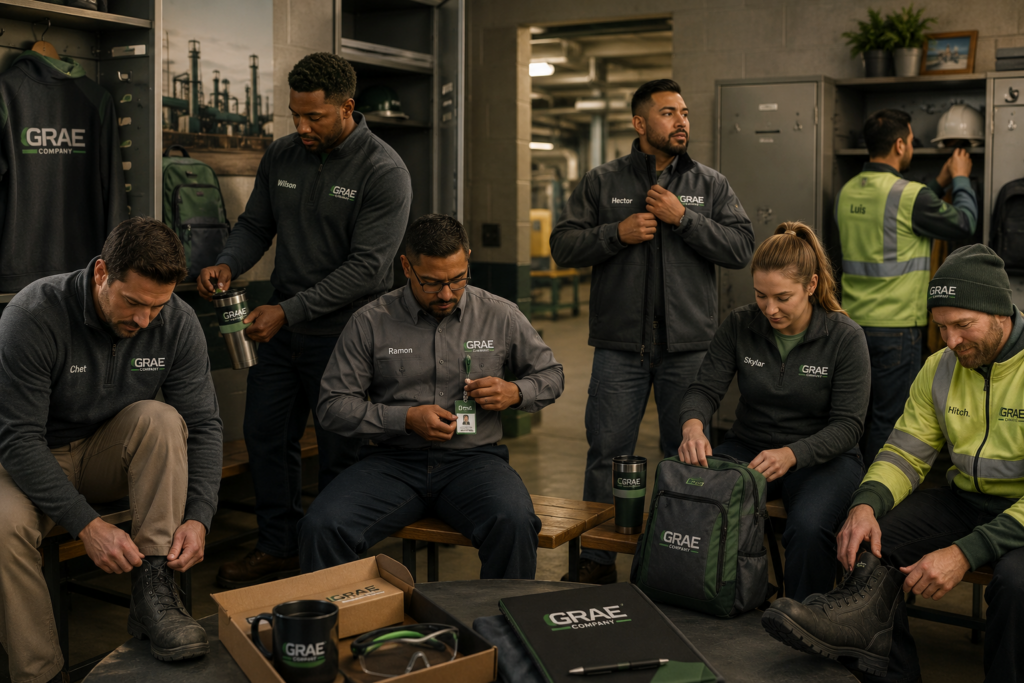
From personalized apparel and safety footwear to onboarding materials and recognition outerwear, coordinated workwear programs shape the employee experience before the workday even begins.
Built Around Your Operation
Every organization distributes something; from uniforms to promotional merchandise to marketing materials.
For healthcare systems, it may be employee apparel, identification materials, and department-specific supplies.
For construction, transportation, utility, manufacturing, and service organizations, it could include branded workwear, PPE, onboarding materials, and safety-related products.
The most effective fulfillment programs are designed around how the organization actually operates.
New Employee Onboarding Kits
Despite the importance of first impressions, Gallup found that only 12% of employees strongly agree their organization does a great job onboarding new employees. Consistent, well-executed onboarding materials, apparel, and employee support resources can help improve that perception in your organization.
When a new hire joins your organization, instead of scrambling to gather materials, a complete onboarding package is assembled and shipped automatically:
- Uniforms
- Identification materials
- Safety information
- Recognition items
- Company-branded merchandise
Everything arrives together, creating a more professional first-day experience.
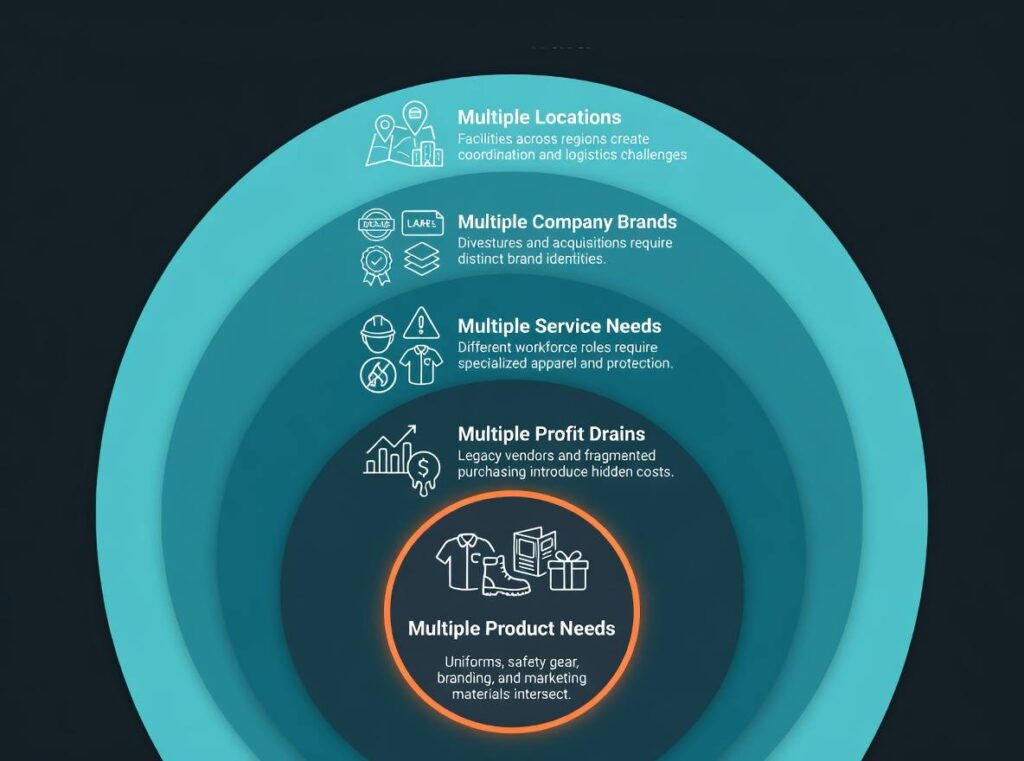
As organizations grow, workforce programs become more complex. Multiple locations, brands, employee roles, products, and operational requirements often require a more integrated approach to apparel, branding, fulfillment, and employee support.
Multi-Location Uniform Distribution
Organizations with multiple facilities often struggle with inventory consistency. Some locations over-order while others run short. Managers spend valuable time managing apparel requests.
Centralized pick-and-pack fulfillment helps standardize distribution, improve visibility, and ensure employees receive approved products regardless of location.
Event and Marketing Fulfillment
Rather than rebuilding event materials from scratch each time, organizations can maintain inventory and distribute preassembled kits as needed for any and all:
- Trade shows
- Customer appreciation programs
- Recruiting events
- Product launches
- Community outreach initiatives
Recognition and Employee Engagement Programs
Recognition programs often fail because distribution becomes difficult.
With centralized fulfillment, organizations can deliver recognition packages, anniversary gifts, incentive awards, and appreciation kits directly to employees wherever they work.
Beyond the Warehouse
Modern fulfillment is no longer just about storage. Today’s programs frequently include:
- Inventory management
- Custom kitting and assembly
- Branded packaging
- Print-on-demand materials
- Promotional products
- Apparel distribution
- Tracking and reporting
- Return management
- Nationwide shipping
- Multi-location replenishment
“Organizations increasingly understand the need for and seek fulfillment partners capable of supporting broader operational objectives beyond simply moving boxes, says Ken Yanicky, Vice President of Feury Image Group. “The ability to integrate warehousing, fulfillment, distribution, inventory visibility, and shipping coordination helps reduce complexity and improve service levels.
Why Newark and New Jersey Remain Strategic Fulfillment Hubs
Location matters. The Newark and Northern New Jersey region remains one of the nation’s most important logistics corridors.
Positioned near major interstate highways, rail infrastructure, ports, airports, and densely populated consumer and workforce markets, the region provides exceptional access to customers and employees throughout the Northeast and beyond.
For organizations operating throughout New Jersey, New York, Connecticut, Pennsylvania, and the Mid-Atlantic region, a strategically located fulfillment operation can help reduce transit times and improve distribution efficiency.
At the same time, national shipping networks allow organizations to support remote employees, branch locations, and customers across the country from a centralized fulfillment strategy.
The Value of Scalability
One of the greatest advantages of outsourced fulfillment is flexibility. A program that supports 100 shipments per month today may need to support 1,000 tomorrow for anything, including:
- Seasonal hiring
- Major events
- Acquisitions
- Expansion into new markets
- Unexpected growth
Organizations that rely solely on internal resources often struggle to scale quickly. Fulfillment partners provide the infrastructure, technology, labor, and logistics expertise necessary to absorb fluctuations without requiring significant capital investment.
More Than Shipping Products
At Feury Image Group, fulfillment is not viewed as a standalone warehouse service.
It is part of a larger operational ecosystem that can include workforce apparel programs, promotional products, branded merchandise, print production, signage, onboarding systems, recognition programs, and technology-enabled ordering platforms.
“The objective isn’t simply to ship a package,” says Yanicky. “It’s to help organizations deliver consistent experiences, support employees, strengthen brands, and reduce operational pain and friction.
“When fulfillment is designed around the way your organization actually works, every shipment becomes more than a delivery. It becomes an extension of your operation.”
More Ideas Built Around You
Fulfillment and distribution are only one part of building workforce programs that support employees, strengthen operations, and improve organizational consistency. Explore additional insights from the Built Around You series.
Multi-Location Uniform Programs: Supporting Employees Across Every Location
Why Workforce Programs Should Be Designed, Not Purchased
FR/AR Programs Built for Real Operations
The Business Case for Hi-Vis Safety Apparel Programs
Uniform Rental vs. Purchase: Which Model Fits Your Organization?
The Value of Personalization in Workforce Apparel Programs
How Workforce Apparel Supports Employee Performance and Engagement
Recruit, Retain, and Reward: Workforce Programs That Strengthen Employee Experience
Healthcare Systems in Motion: Supporting Complex Healthcare Operations Beyond the Uniform
FAQ
What types of items can be included in a pick-and-pack program?
Uniforms, workwear, promotional products, onboarding kits, printed materials, safety equipment, recognition gifts, trade show and event materials supplies, and branded merchandise.
Can pick-and-pack services support multiple locations?
Yes. Many organizations across industries use centralized fulfillment to distribute products to employees, facilities, branches, and customers nationwide.
Is pick-and-pack only for ecommerce companies?
No. Healthcare systems, manufacturers, transportation providers, utilities, educational institutions, construction firms, and corporate organizations frequently use fulfillment services to support workforce and operational programs.
What are the primary benefits of outsourced fulfillment?
Reduced administrative burden, improved scalability, better inventory visibility, faster distribution, lower infrastructure requirements, and the ability to focus internal resources on core business functions.
How does fulfillment fit into workforce apparel programs?
Fulfillment helps ensure employees receive approved apparel, safety gear, onboarding materials, and replacement items quickly and consistently, regardless of location.